High electricity bills have become a major burden for families across Punjab. To tackle this, Chief Minister Maryam Nawaz Sharif introduced the Roshan Gharana Program. This initiative aims to provide free or subsidized solar energy to thousands of households.
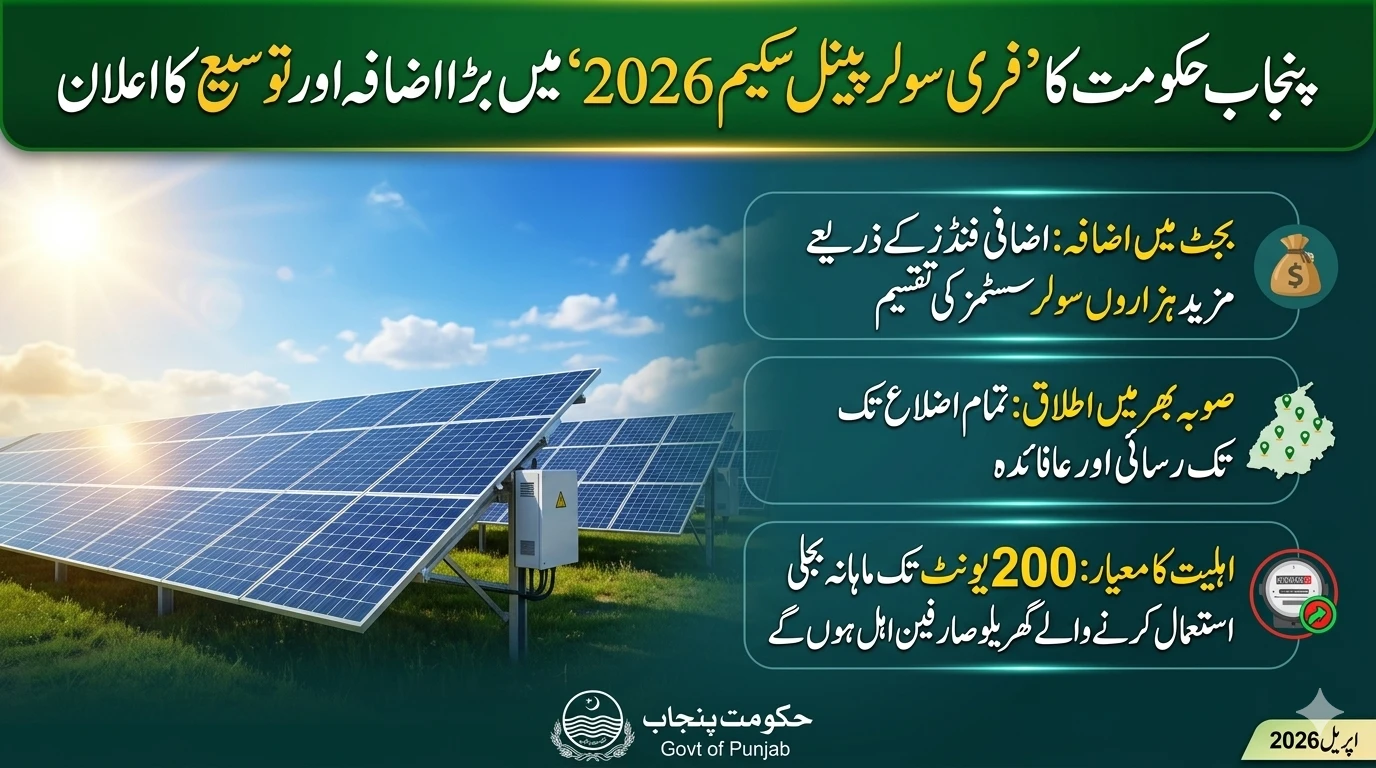
As of April 2026, the government has announced a massive expansion of this project. With new funds and updated rules, more people than ever can now switch to clean, free energy. If you are struggling with monthly bills, this guide will show you exactly how to benefit from this scheme.
What is the Punjab Solar Relief Program?
The Punjab Free Solar Panel Scheme is a multi-billion rupee project designed to shift low-income families toward renewable energy. Instead of relying solely on the national grid, households can generate their own power.
The goal is simple: reduce the load on the power grid and give financial breathing room to the poor. The government provides high-quality solar kits, including panels and inverters, to those who qualify.

New Updates for April 2026: The 200-Unit Extension
The most recent update from the Chief Minister’s office has changed the game. Originally, the scheme targeted a smaller group. However, due to high demand and rising costs, the government has decided to expand the program until December 2026.
Key changes include:
- Increased Budget: More funds have been allocated to cover more districts.
- Wider Reach: The program is no longer limited to major cities like Lahore or Faisalabad; it now covers rural areas across the province.
- Priority for 200-Unit Users: Households consuming up to 200 units of electricity are now at the top of the priority list.
Detailed Eligibility Criteria: Do You Qualify?
To ensure the help reaches those who truly need it, the Punjab government has set specific rules. You cannot just apply without meeting these requirements.
1. Electricity Consumption Limits
The primary factor is your electricity usage history. The government checks your bills from the last six months. If your average monthly consumption is between 100 and 200 units, you are eligible for the free solar kit.
2. Residency and Citizenship
You must be a permanent resident of Punjab. A valid CNIC (Computerized National Identity Card) is mandatory. The address on your CNIC should match the address on your electricity bill.

3. Financial Status
This scheme is meant for low and middle-income families. People who are already registered with the Benazir Income Support Programme (BISP) or other social safety nets often get extra points during the selection process.
4. Property Requirements
You must have a concrete roof or a stable area where panels can be safely installed. Since these are 550-watt panels, they require a specific amount of space and sunlight.
Step-by-Step Registration Guide
Applying for the Punjab Free Solar Panel Scheme is now easier than before. You don’t have to wait in long lines at government offices. Here are the two main ways to register.
Method 1: Registration via SMS (The 8800 Code)
This is the fastest method for most people.
- Open the messaging app on your phone.
- Type your CNIC number followed by your Electricity Bill Reference Number.
- Send this message to 8800.
- You will receive a confirmation message. This enters your name into the initial screening database.
Method 2: Online Portal Registration
If you prefer using a computer or smartphone:
- Visit the official Punjab Information Technology Board (PITB) or the dedicated Roshan Gharana web portal.
- Fill out the application form with your personal details.
- Upload a scanned copy of your latest electricity bill and CNIC.
- Submit the form and save your application ID for tracking.
Method 3: Bank Visit
Selected branches of the Bank of Punjab (BOP) also accept physical applications. You can take your documents to the nearest branch, and the staff will help you fill out the paperwork.
What is Included in the Free Solar Kit?
The government is not just giving away panels; they are providing a complete energy solution. The “Solar Kit” usually includes:
- 550-Watt Solar Panels: High-efficiency panels capable of generating significant power.
- Inverter: A device that converts solar energy into usable electricity for your home appliances.
- Battery System: To ensure you have power during the night or on cloudy days.
- Mounting Structure: Frames to hold the panels securely on your roof.
- Wiring and Installation: Professional teams handle the setup to ensure safety.
How the Selection Process Works
Since there are millions of users in Punjab but a limited number of solar kits, the government uses a Balloting System (Qurandazi).
Once the registration phase ends, a computerized lucky draw is held. This ensures fairness. If your name is drawn, a government team will visit your house to verify your details and check if your roof is suitable for installation. After verification, the kit is delivered and installed within a few weeks.
Why the Punjab Government is Investing in Solar
You might wonder why the government is spending so much money on free solar panels. There are three main reasons:
- Grid Relief: During the hot summer months, the national grid often fails due to high demand. Solar energy reduces this pressure.
- Economic Stability: When poor families save money on electricity bills, they spend that money on food, education, and health. This boosts the local economy.
- Environmental Goals: Moving toward green energy helps reduce pollution and meets international climate standards.
Common Challenges and Solutions
While the program is great, some users face issues. Here is how to handle them:
- Wrong Information: If your CNIC name doesn’t match your bill, you might be rejected. Visit your local WAPDA/LESCO office to correct your bill details before applying.
- Rented Homes: If you live in a rented house, you need a “No Objection Certificate” (NOC) from your landlord to install the panels.
- SMS Not Sending: Ensure you have enough balance on your SIM card and that you are using the correct format (CNIC [Space] Bill Reference Number).
Pro Tips for a Successful Application
- Pay Your Bills on Time: The government looks at your payment history. Defaulters are rarely selected for the scheme.
- Double Check the Reference Number: Your bill has a 14-digit reference number. Make sure every digit is correct in your SMS or online form.
- Keep Your Phone Active: All updates regarding your application will come via the phone number you used during registration.
Frequently Asked Questions (FAQs)
1. Is the Punjab Solar Scheme completely free?
For those consuming under 100 units, it is mostly free. For those between 100-200 units, it is a highly subsidized model where the government pays the majority of the cost, and the user pays a very small installment through their bill.
2. Can I sell the solar panels after getting them?
No. The panels are tagged and registered to your CNIC and electricity meter. Selling government-provided solar panels is illegal and can lead to heavy fines or legal action.
3. What if my electricity usage is more than 200 units?
Currently, the “free” and “highly subsidized” focus is on those under 200 units. However, the government has separate interest-free loan schemes for users consuming up to 500 units.
4. How long do the solar panels last?
The panels provided in this scheme are Tier-1 quality and usually come with a warranty of 20 to 25 years. The inverters typically have a 5 to 10-year warranty.
5. How can I check my application status?
You can check your status by sending your CNIC to 8800 again or by logging into the official Punjab Solar portal using your tracking ID.
Conclusion
The Punjab Free Solar Panel Scheme 2026 is a golden opportunity for low-income families to escape the cycle of rising electricity costs. By expanding the program to include 200-unit users and increasing the budget, CM Maryam Nawaz has shown a commitment to public relief.
Don’t wait until the deadline. Check your latest bill, gather your documents, and apply via SMS or the online portal today. Transitioning to solar is not just about saving money—it’s about securing a brighter, more independent future for your home.