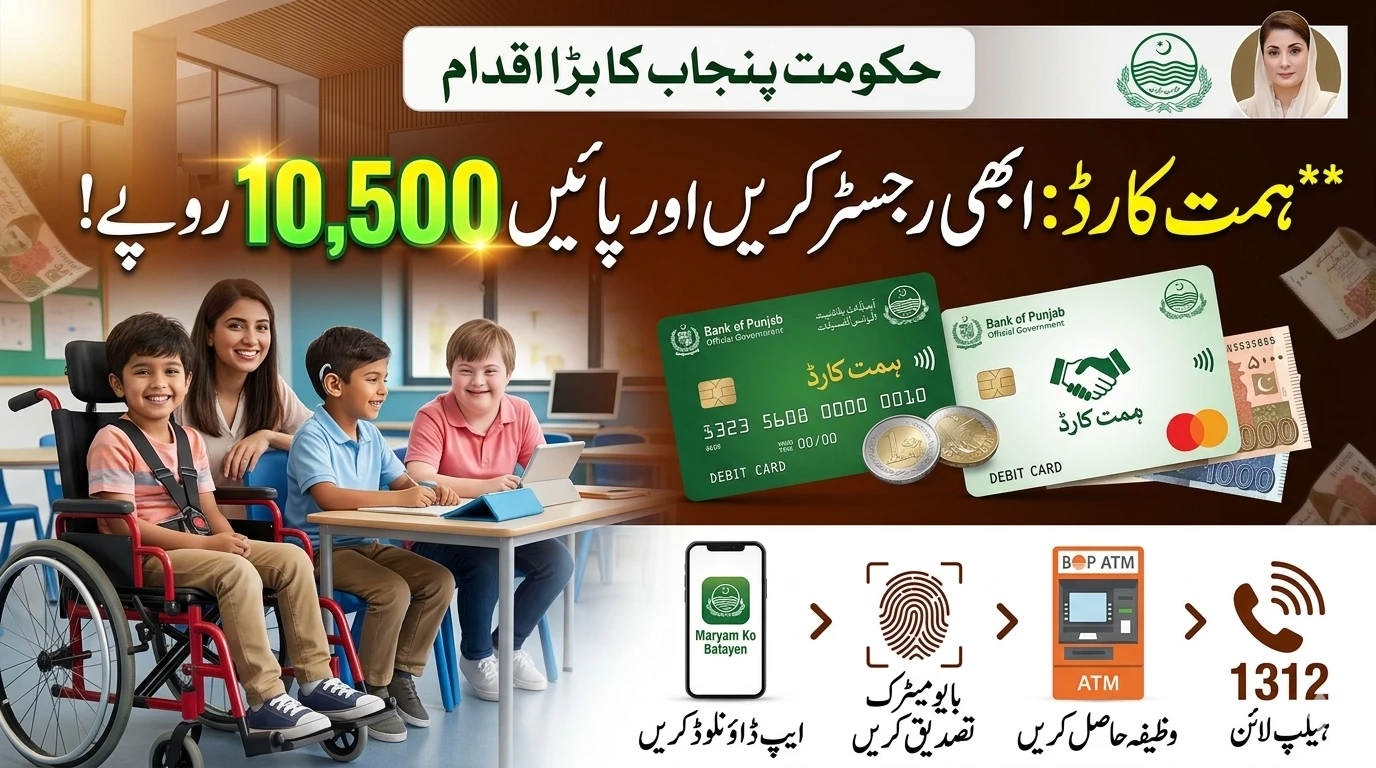
The Punjab government has taken a significant step toward supporting its most vulnerable citizens. For families with children in the Special Education (SE) department, the “Himmat Card” is no longer just a promise—it is a reality. This program provides a quarterly stipend of Rs 10,500 to individuals with disabilities who are “not fit to work.”
Recently, the focus has shifted specifically toward students enrolled in special education schools across the province. The goal is simple: ensure that no child’s education or well-being is hindered by financial struggle. If you are a parent or guardian of a special student, this guide will help you navigate the registration process with ease.
Why the Himmat Card is a Game-Changer for SE Students
For years, many families struggled to afford the specialized care, transportation, and school supplies required for children with special needs. The Himmat Card, a flagship project of Chief Minister Maryam Nawaz, aims to bridge this gap.
By providing Rs 10,500 every three months, the government is offering a consistent safety net. For a student in a Special Education school, this money can cover medical checkups, hearing aids, wheelchairs, or even basic household expenses. It empowers the family and gives the student a sense of dignity.
Eligibility Criteria: Who Can Apply?
Not every person with a disability is eligible for the Himmat Card. The government has set specific filters to ensure the money reaches those who need it most.
1. The “Not Fit to Work” Status
The primary requirement is that the applicant must have a disability that prevents them from engaging in regular employment. This is usually verified through a disability certificate issued by the Social Welfare Department.
2. Enrollment in Special Education
Currently, there is a massive drive to register students who are already part of the Punjab Special Education Department’s network. Being an active student in a government SE school makes the verification process much faster.
3. The PMT Score Requirement
The government uses the Proxy Means Test (PMT) score from the Benazir Income Support Programme (BISP) database. Generally, families with a PMT score below 45 are prioritized. This ensures the relief goes to low-income households.
Essential Documents for Registration
Before you begin the registration process, you must have your paperwork in order. Missing a single document can lead to delays or rejection. Ensure you have the following:
- CNIC or B-Form: The student’s National Identity Card (for those over 18) or B-Form (for minors).
- Disability Certificate: An official certificate from the Social Welfare and Bait-ul-Maal Department.
- Parent/Guardian CNIC: A copy of the father’s or mother’s identity card.
- Mobile Number: A SIM card registered in the name of the applicant or their legal guardian.
- Proof of Enrollment: A certificate or ID card from the Special Education school where the child is studying.
Step-by-Step Himmat Card Registration for SE Students
The registration process is a collaborative effort between the Special Education Department and the Social Welfare Department. Here is how you can complete it:
Step 1: Update Your Data at School
Most Special Education schools in Punjab are now acting as primary data collection points. Contact your child’s school principal. Ensure that your child’s data is correctly entered into the department’s internal portal.
Step 2: Visit the Social Welfare Office
If your child is not yet registered in the Disability People Management Information System (DPMIS), you must visit your local District Social Welfare Office. They will scan your documents and update your status in the provincial database.
Step 3: Biometric Verification
Once your data is processed, you will receive an SMS from the government (usually from 8171 or a dedicated Punjab portal). You will then need to visit a designated Bank of Punjab (BOP) branch or an e-Khidmat Markaz for biometric verification. This step confirms that the person receiving the card is the actual beneficiary.
Step 4: Collecting the Himmat Card
After successful verification, your Himmat Card will be issued. You can collect it from the designated BOP branch. This card works like a standard ATM card and can be used at any Bank of Punjab ATM to withdraw your stipend.
How the Payment System Works
The Himmat Card is designed for transparency. The Rs 10,500 stipend is released every quarter (three months). You do not need to visit a government office to collect the cash.
Once the funds are moved into your account, you will receive an SMS notification. You can then go to any BOP ATM, insert your card, and withdraw the full amount. There are no “hidden fees” or cuts taken by middlemen. The full amount belongs to the student.
Common Challenges and How to Solve Them
While the process is designed to be smooth, parents often face a few hurdles. Here is how to handle them:
- Expired CNIC: If your or your child’s CNIC has expired, the bank will not issue the card. Always renew your ID cards at NADRA before starting the Himmat Card process.
- Incorrect Phone Number: If you change your mobile number, you might miss the notification SMS. Always provide a number that stays active.
- Biometric Failure: Older people or those with certain physical conditions might face issues with fingerprint scanning. In such cases, you can ask the bank for “Eye Verification” or alternative NADRA-approved methods.
The Role of the 1312 Helpline
If you are confused about your application status, the Punjab government has launched the 1312 helpline. This is a dedicated line for the Social Welfare Department. By calling this number, you can:
- Check if your Himmat Card is ready.
- Report issues with the registration staff.
- Inquire about the next payment date.
- Get directions to the nearest registration center.
Why You Should Act Immediately
The Punjab government is currently in a “fast-track” mode to cover all Special Education students. By registering now, you ensure that your child is included in the next payment cycle. Delaying the process could mean waiting several more months for the next budget allocation.
Moreover, having a Himmat Card opens doors to other provincial benefits, such as subsidized assistive devices (hearing aids, prosthetic limbs) and priority seating in public transport.
Conclusion
The Himmat Card Registration for SE Students is a vital step toward a more inclusive Punjab. It provides more than just money; it provides a sense of security to parents who worry about their children’s future.
By following the steps outlined above and keeping your documents updated, you can secure this financial aid for your child. Don’t let the paperwork intimidate you—the teachers at SE schools and the staff at Social Welfare offices are there to help you every step of the way.
Frequently Asked Questions (FAQs)
1. Can a student with a minor disability get the Himmat Card?
The card is specifically for those with a “Permanent Disability” who are classified as “not fit to work.” Minor or temporary disabilities may not qualify for this specific quarterly stipend.
2. Is there any fee for the Himmat Card registration?
No. The entire process, from the application at the school to the issuance of the card at the Bank of Punjab, is absolutely free. If anyone asks for money, report them to the 1312 helpline immediately.
3. What if I already receive BISP (8171) money?
In many cases, the Himmat Card is an additional benefit for the disabled individual, even if the family receives BISP. However, eligibility is ultimately determined by the PMT score and the specific disability status.
4. How long does it take to get the card after registration?
Once the biometric verification is complete, it usually takes 2 to 4 weeks for the Bank of Punjab to print and distribute the card to your local branch.
5. Can I use the Himmat Card at any ATM?
While it is a Bank of Punjab card, it can generally be used at other ATMs. However, using a BOP ATM is recommended to avoid extra bank charges and to ensure a smoother transaction.