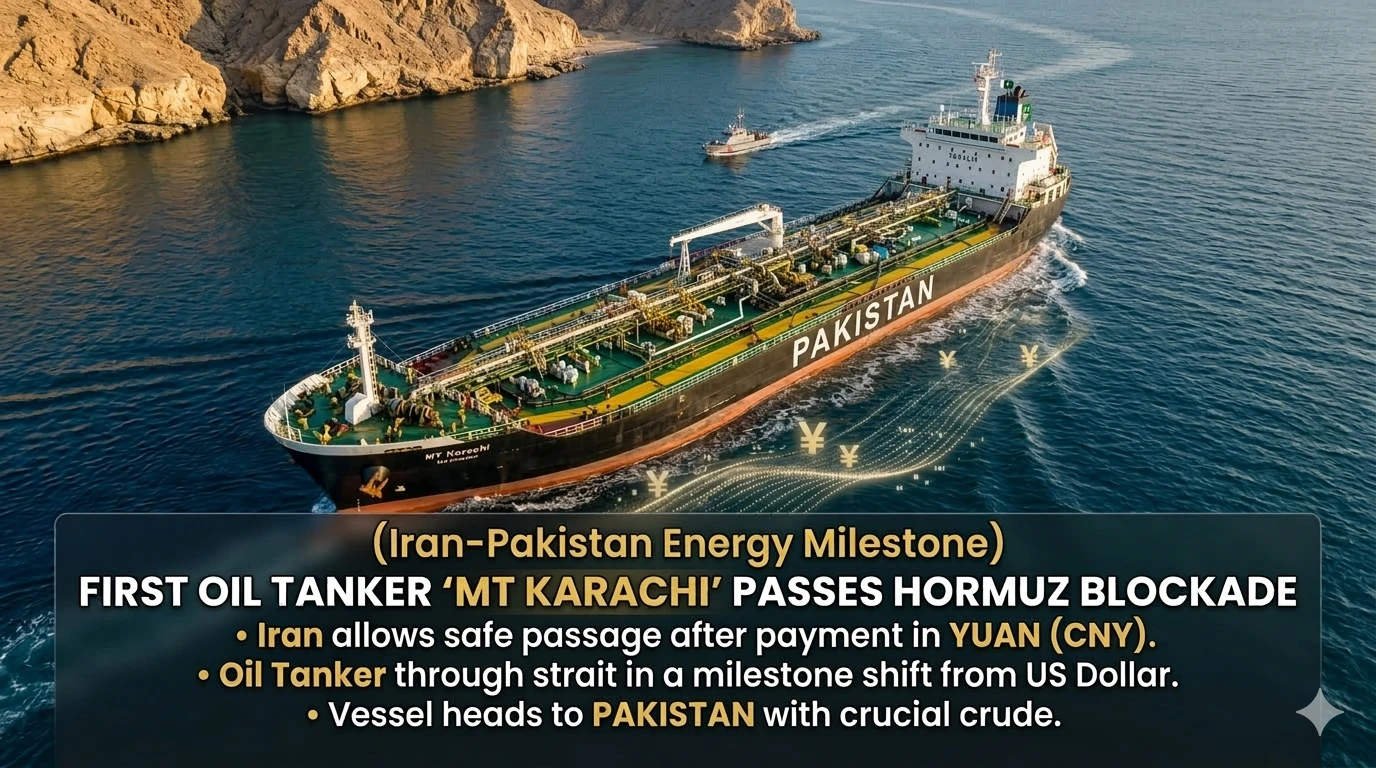
The global energy landscape just witnessed a historic shift. For the first time, a Pakistani oil tanker, the MT Karachi, has successfully navigated the heavily restricted Strait of Hormuz after a shipment was settled using the Chinese Yuan (CNY). This development is not just about a single ship; it represents a major turning point in how nations bypass traditional financial systems to secure vital energy supplies.
As the Middle East faces heightened tensions, this “Yuan-for-passage” model offers a glimpse into a new era of trade. For the people of Pakistan, who have been struggling with record-high fuel prices and supply chain uncertainty, the arrival of this vessel is more than just a headline—it is a lifeline.
The Journey of MT Karachi: A High-Stakes Transit
The MT Karachi, an Aframax-class tanker operated by the Pakistan National Shipping Corporation (PNSC), became a symbol of diplomatic success on March 15, 2026. While the Strait of Hormuz has been effectively closed to most Western-aligned commercial traffic, the MT Karachi crossed the narrow chokepoint with its Automatic Identification System (AIS) turned on.
This transparency is rare in the current “shadow fleet” era. Usually, vessels in contested waters turn off their trackers to avoid detection. By keeping its AIS active, the MT Karachi signaled to the world that its passage was not a covert operation but a negotiated safe transit.

Key Details of the Shipment:
- Vessel Name: MT Karachi (built in 2022, 109,990 DWT)
- Cargo: Das Crude (loaded at Das Island, Abu Dhabi)
- Payment Currency: Chinese Yuan (CNY)
- Route: Das Island -> Strait of Hormuz -> Karachi Port
Why the “Yuan Deal” is a Game Changer
For decades, the “Petrodollar” has been the undisputed king of oil trade. Almost all international oil transactions have been conducted in US Dollars. However, the current geopolitical climate has forced a rethink.
By accepting Yuan for the transit and cargo of the MT Karachi, Iran is pushing a de-dollarization agenda that has long been discussed but rarely executed on this scale. For Pakistan, this shift provides a way to maintain its energy security without being entirely dependent on the availability of US Dollars, which have been in short supply in the local market.
The Benefits for Pakistan’s Economy
- Reduced Pressure on Dollar Reserves: Settling trades in Yuan allows Pakistan to preserve its scarce US Dollar reserves for other critical debt repayments.
- Stable Energy Supply: With the Strait of Hormuz being a primary chokepoint for 20% of the world’s oil, having a “safe passage” agreement ensures that refineries in Karachi don’t run dry.
- Diplomatic Flexibility: This move shows that Pakistan can navigate complex relationships with Iran, China, and the UAE simultaneously.
Impact on Petrol Prices in Pakistan
The most pressing question for every Pakistani is: “Will petrol prices go down?”

In early March 2026, petrol and diesel prices in Pakistan saw a massive hike of Rs 55 per litre due to the blockade and rising global Brent prices. While a single tanker won’t immediately slash prices at the pump, it provides the market stability needed to prevent further panic-buying.
The government has indicated that petroleum stocks are currently “comfortable” until mid-April. If more shipments follow the MT Karachi using the Yuan-based settlement, we could see a gradual softening of prices as the “war premium” on shipping insurance begins to fade for Pakistani-flagged vessels.

The Strategic Importance of the Strait of Hormuz
To understand why this is a “milestone shift,” one must look at the geography. The Strait of Hormuz is only 21 nautical miles wide at its narrowest point. It is the only way for oil to leave the Persian Gulf by sea.
Since the escalation of hostilities in early March, nearly 70% of tanker traffic has halted. Most ships are now taking the long route around the Cape of Good Hope, adding 14 days to their journey and millions of dollars to their fuel costs. The MT Karachi’s direct route saved both time and money, proving that the “Yuan Deal” has tangible economic benefits.
Future Outlook: A New Trade Corridor?
The success of this transit may encourage other non-aligned nations to adopt the Yuan-based settlement model. If China continues to act as a strategic guarantor for these shipments, we could see a permanent “Green Channel” in the Strait of Hormuz for countries that agree to move away from the US Dollar.
For your website, pesrp.pk, this story is a perfect example of how global politics directly affects the local consumer’s pocket. Monitoring the progress of the next PNSC tanker, the MT Lahore, will be crucial in the coming days.
❓ Frequently Asked Questions (FAQs)
1. Why did Iran allow the MT Karachi to pass when others are blocked?
Iran has implemented a “selective passage” policy. Nations that are non-aligned in the current Western conflict and agree to settle trades in alternative currencies (like the Chinese Yuan) are being granted safer passage than those using the US Dollar or Western-flagged vessels.
2. How does the Yuan payment help the common man in Pakistan?
It helps by reducing the demand for US Dollars in the interbank market. When the government doesn’t have to scramble for Dollars to pay for oil, the Rupee remains more stable, which eventually prevents massive inflation and fuel price hikes.
3. Is the MT Karachi safe now?
Yes, as of March 16, 2026, the vessel has cleared the Strait and is in the waters off Sohar, Oman. It is expected to dock at Karachi Port by March 17 or 18.
4. What is an Aframax-class tanker?
It is a medium-sized tanker (80,000 to 120,000 tons) that is highly versatile. It can enter most major ports that are too shallow for the “Mega-Tankers” (VLCCs), making it perfect for Pakistan’s maritime infrastructure.
5. Will there be more oil shipments like this?
The Pakistan National Shipping Corporation (PNSC) has recently expanded its fleet with vessels like the MT Lahore and MT Quetta. If this Yuan-based model continues to work, it is highly likely that more shipments will follow this route.