Preparing for a government teaching job in Pakistan is a journey that requires both dedication and the right resources. Among the most sought-after positions are those within the Federal Govt Educational Institution (C/G) network. If you are aiming for an Elementary School Teacher (EST) BPS-14 role, you likely know how competitive these exams can be.
The best way to get an edge is by studying original past papers. They don’t just give you the answers; they reveal the examiner’s mindset. In this guide, we break down the 2025 FGEI induction paper, providing insights into the syllabus, question types, and how you can ace the next session in 2026.
Why FGEI EST Past Papers are Essential for Success
Most candidates spend months reading thick textbooks without knowing what to focus on. Original past papers act as a compass. For the EST (BPS-14) exam, the Federal Government Educational Institution often balances academic knowledge with professional teaching skills.
By reviewing the 2025 paper from the Sir Syed Road Rawalpindi induction, you can see a clear distribution of marks. The test isn’t just about how much you know about Science or Math; it’s about how well you understand the “Art of Teaching” (Pedagogy) and your command of the English language.

Breakdown of the FGEI EST 2025 Test Pattern
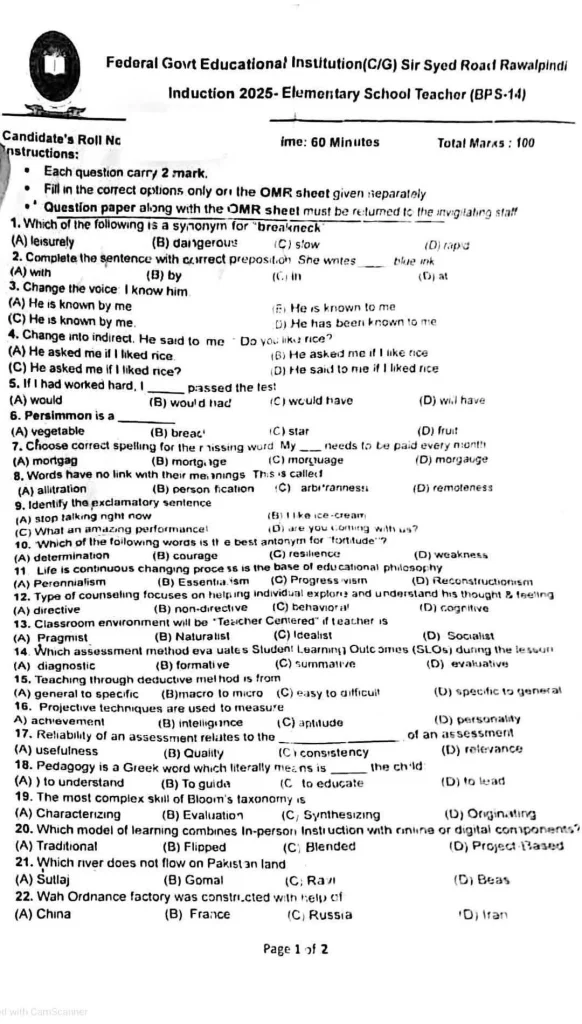
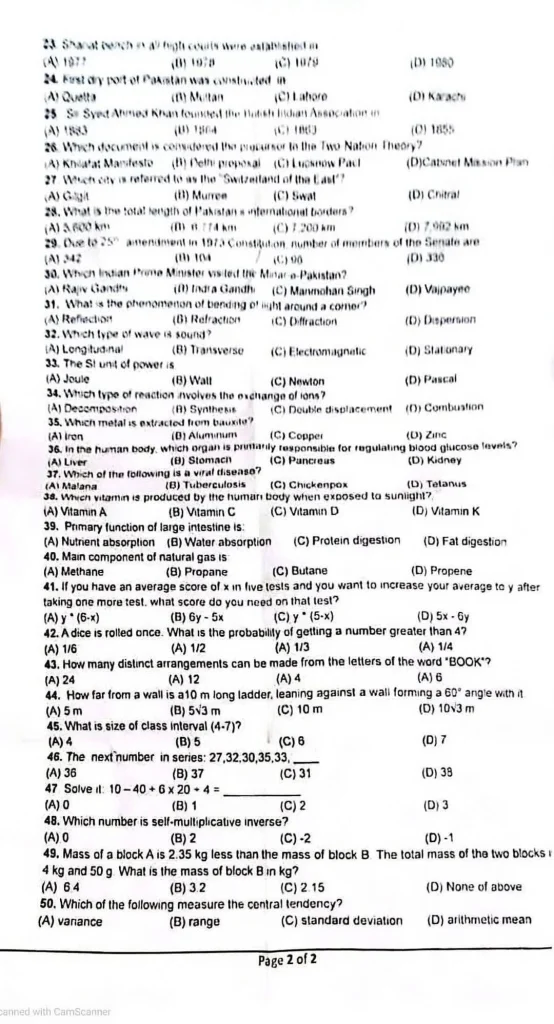
The 2025 induction test was a 60-minute challenge consisting of 50 Multiple Choice Questions (MCQs), with each carrying 2 marks. To score 100%, you need to be quick and accurate. The paper is generally divided into four major pillars:
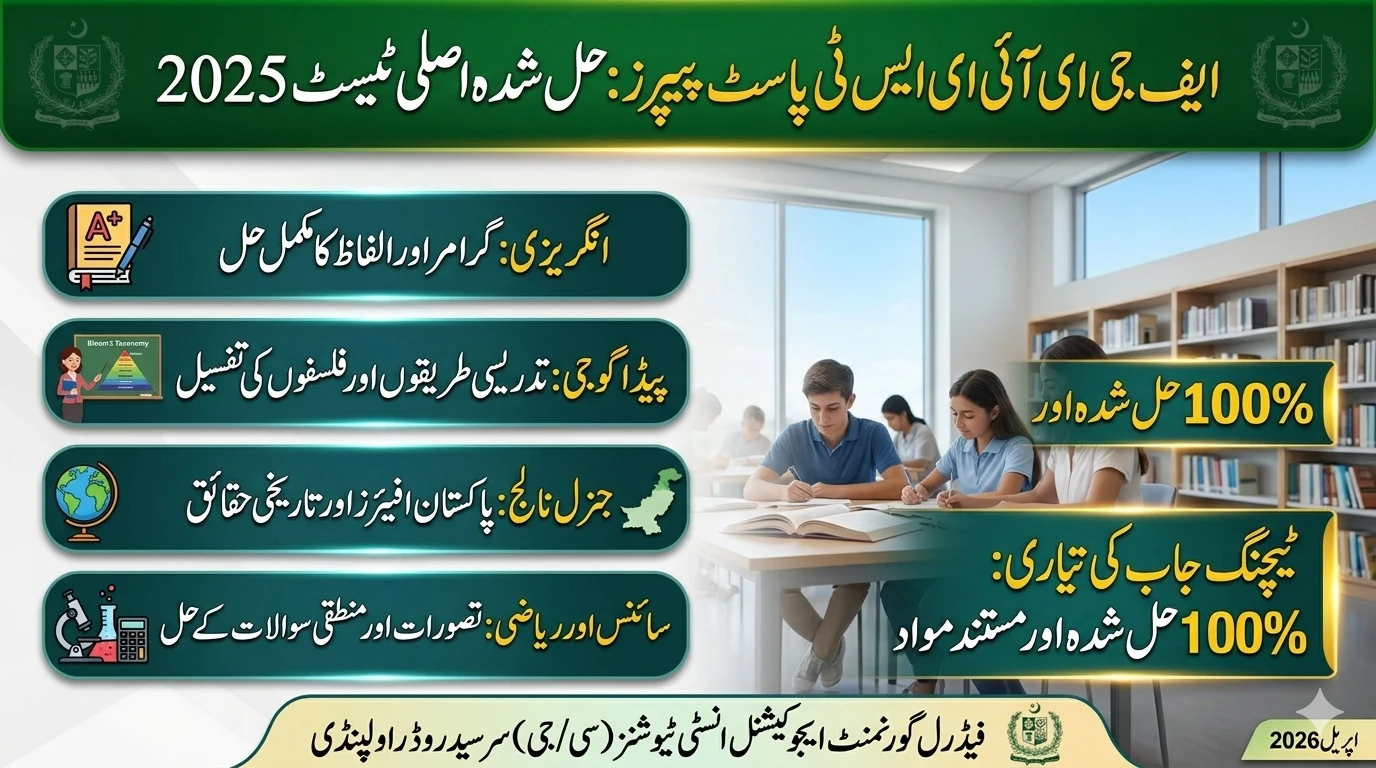
- English Language and Verbal Ability
- Pedagogy and Educational Philosophy
- General Knowledge and Pakistan Studies
- General Science and Mathematics
Let’s dive deep into each section to see what was asked and how you should prepare.
Section 1: Mastering English and Grammar
English is often the “make or break” section for many candidates. In the 2025 FGEI paper, the focus was on functional grammar rather than complex literature.

Key Topics Asked:
- Synonyms: Understanding vocabulary in context (e.g., words like “breakneck”).
- Prepositions: Knowing the difference between “writing with a pen” versus “writing in blue ink.”
- Voice and Narration: Converting active voice to passive and direct speech to indirect.
- Sentence Structure: Identifying exclamatory or interrogative sentences.
To prepare for this, don’t just memorize lists of words. Instead, practice the “rules of change” for Active/Passive and Direct/Indirect speech. These are high-yield topics that appear in almost every FGEI test.
Section 2: Pedagogy and Teaching Methodology
For an EST (BPS-14) role, pedagogy is the core of the exam. This section tests if you actually know how to manage a classroom and help students learn.

Important Concepts from the 2025 Paper:
- Bloom’s Taxonomy: Understanding the levels of learning, from basic recall to the most complex skill, which is Evaluation or Synthesizing.
- Educational Philosophies: Questions on Progressivism (viewing life as a continuous changing process) and Idealism (teacher-centered environments).
- Assessment Methods: Knowing the difference between Formative assessment (during the lesson) and Summative assessment (at the end).
- Learning Models: The rise of Blended Learning, which combines in-person teaching with digital tools.
If you want to score high here, focus on the Greek roots of words like “Pedagogy” (meaning to lead the child) and the deductive vs. inductive methods of teaching.
Section 3: General Knowledge and Pakistan Affairs
This section tests your awareness of the world around you and the history of your country. The FGEI examiners like to mix historical facts with geographical data.
Notable Questions from the Test:
- History: The role of Sir Syed Ahmed Khan and the British Indian Association (1866).
- Geography: Pakistan’s international borders and major rivers (e.g., noting that the Beas river does not flow through Pakistan).
- Current Affairs: Indian Prime Ministers visiting Pakistan (Vajpayee’s visit to Minar-e-Pakistan).
- National Facts: The establishment of Shariat benches (1979) and the first dry port in Lahore.
A great tip for this section is to read about the 1973 Constitution and its various amendments, especially the 25th amendment which impacted the Senate and tribal areas.
Section 4: General Science and Mathematics
The Science and Math section is designed to test your logic and basic analytical skills. These are usually at the 8th to 10th-grade level but can be tricky under time pressure.
Science Highlights:
The 2025 paper touched on Biology, Physics, and Chemistry:
- Biology: Organ functions like the Pancreas regulating glucose or the Large Intestine absorbing water.
- Physics: Concepts like the Diffraction of light and SI units of power (Watt).
- Chemistry: Main components of natural gas (Methane) and metal extraction (Aluminum from Bauxite).
Mathematics and Logic:
You don’t need to be a mathematician, but you must know:
- Probability: Calculating the odds of a dice roll.
- Algebra: Solving for averages (x and y variables).
- Geometry: The “ladder against the wall” problem using trigonometric ratios (Soh-Cah-Toa).
- Basic Arithmetic: Following the BODMAS rule (Brackets, Orders, Division, Multiplication, Addition, Subtraction).
FGEI EST Past Papers
Preparation Strategy for the 2026 FGEI Induction
If you are planning to sit for the next Elementary School Teacher exam, follow this simple roadmap:
- Solve as You Go: Don’t just read the questions in the FGEI EST past papers; try to solve them under a 60-minute timer.
- Focus on Pedagogy: This is 20-30% of the test. Read the B.Ed or M.Ed curriculum basics.
- Watch the News: Stay updated on regional geography and constitutional changes in Pakistan.
- Math Practice: Revise 9th and 10th-grade Math formulas, especially those related to averages, ratios, and basic geometry
- .https://maryamkobatain.pk/fgei-jobs-2026-apply-online/
Frequently Asked Questions (FAQs)
1. What is the syllabus for the FGEI EST BPS-14 test?
The syllabus generally includes English (20%), Pedagogy (25%), General Knowledge/Current Affairs (20%), Mathematics (15%), and General Science (20%). However, these percentages can shift slightly each year.
2. Is there negative marking in the FGEI induction test?
Usually, FGEI induction tests do not have negative marking, but you should always check the instructions on your specific question paper before starting.
3. How many marks are required to pass the FGEI EST exam?
While the passing mark is typically 50%, the merit list for Rawalpindi or Lahore stations often closes much higher (around 70-80%) due to high competition.
4. Can I apply for the BPS-14 role with a simple BA/BSc?
A Bachelor’s degree is required, but FGEI often prioritizes candidates with professional teaching degrees like B.Ed or M.Ed, especially for the EST role.
5. Where can I find more FGEI EST Past Papers?
You can find them on educational portals, or by following the official FGEI recruitment updates. Always look for “Original Papers” to ensure you are studying the correct material.
Final Thoughts
Success in the FGEI EST (BPS-14) exam isn’t about luck; it’s about strategy. By using these FGEI EST Past Papers as your foundation, you can identify your weak spots early. Whether it’s mastering the nuances of Bloom’s Taxonomy or brushing up on your 9th-grade Algebra, every bit of preparation counts.
Stay focused, keep practicing, and you’ll be well on your way to securing a prestigious teaching position in the Federal Government Educational Institutions.
Disclaimer: This article is based on the 2025 induction paper for informational purposes. Always check the official FGEI portal for the latest recruitment policies and syllabus updates.