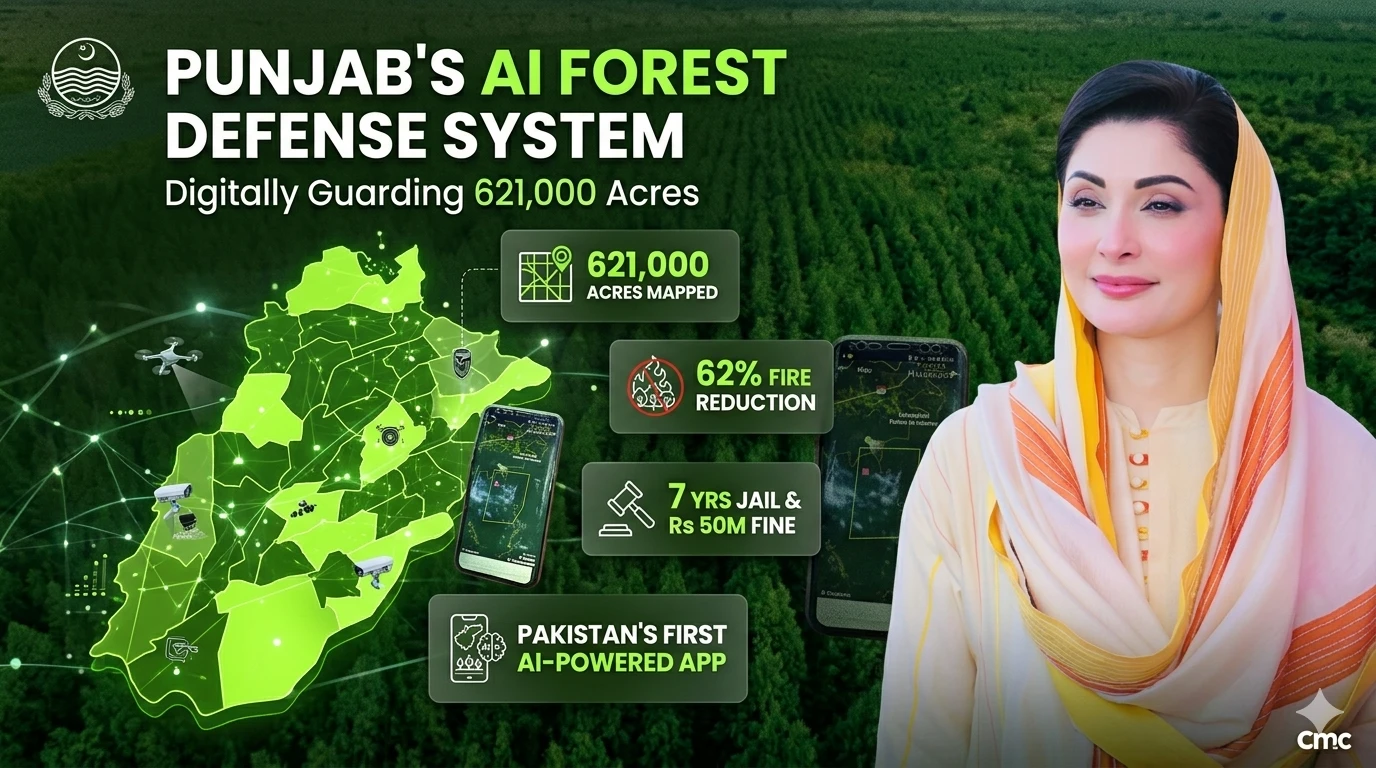
For a long time, looking after a forest in Pakistan meant having a few guards walk through thousands of acres of thick trees. It was a tough job, and honestly, it was almost impossible to see everything. Fires would start and spread before anyone noticed. Illegal loggers would slip in and out under the cover of night. But things are changing fast in Punjab.
The province has stepped into a new era of environmental protection. By using artificial intelligence (AI) and digital mapping, Punjab is now watching over 621,000 acres of forest land. This isn’t just a small upgrade; it’s a total shift in how we keep our “green lungs” safe.
The Digital Shield: Mapping 621,000 Acres
Imagine trying to keep track of a backyard that is over 600,000 acres large. You can’t be everywhere at once. This is where digital mapping comes in. Punjab has successfully created a digital footprint for its entire forest reserve.
This mapping process involves using satellites to draw exact lines around protected areas. It creates a “base layer” of what the forest looks like today. If a patch of trees disappears tomorrow, the system knows. There is no more guesswork or relying on old, dusty paper records that can be lost or changed.

By having a digital record, the government has created a transparent system. Everyone knows exactly where the forest starts and where it ends. This makes it much harder for people to slowly “encroach” or take over forest land for farming or building.
Pakistan’s First AI-Powered Monitoring App
At the heart of this change is a new mobile application. It is the first of its kind in Pakistan. While we use apps for food and rides, the Punjab Forest Department is now using them to save the planet.
This app uses AI to process data from the field and from space. Here is how it helps the people on the ground:

- Live Reporting: Rangers can take photos and upload data instantly.
- GPS Tracking: Every report is tagged with an exact location, so backup knows exactly where to go.
- Predictive Analysis: The AI looks at weather patterns and past events to predict where a fire might be likely to start.
This technology takes the “human error” out of the equation. In the past, a report might take days to reach an office. Now, it happens in seconds.
Crushing the Flames: A 62% Drop in Forest Fires
Forest fires are a nightmare for biodiversity. They destroy habitats, kill wildlife, and release massive amounts of carbon into the air. In the past, the heat in Punjab made these fires a regular and tragic occurrence.

However, since the introduction of digital surveillance, there has been a 62% reduction in forest fires. This is a massive win. But how did an app stop a fire?
It’s all about early detection. AI-powered cameras and satellite sensors can detect “heat signatures”—small spots that are much hotter than the surrounding ground. When the system spots one of these, it alerts the nearest team. By catching a fire when it is just a small bushfire, rangers can put it out before it turns into a massive disaster.
Ending the Era of Illegal Logging
Illegal cutting, often done by what people call the “timber mafia,” has been a thorn in Pakistan’s side for decades. Trees that took 50 years to grow are cut down in 50 minutes.
The new system makes this “business” very risky. With AI monitoring, the canopy (the top layer of the forest) is checked constantly. If the canopy thins out in a specific area, the system flags it as potential illegal cutting.
To back up this technology, the government has introduced incredibly strict laws:
- 7 Years of Jail Time: This isn’t just a fine; it’s serious prison time for those destroying the environment.
- Rs 50 Million Fine: The financial penalty is now high enough to bankrupt most illegal operations.
When you combine “eyes that never sleep” (AI) with “punishments that hurt” (the law), you get a real deterrent.
Why This Matters for Your Daily Life
You might think, “I live in a city, why should I care about 600,000 acres of trees far away?” The truth is, these forests are the only reason our cities stay livable.
Cooling the Air
Pakistan is one of the countries most affected by global warming. Forests act as natural air conditioners. They lower the local temperature. Without these 621,000 acres, the heatwaves in cities like Multan or Lahore would be even more unbearable.
Cleaner Water
Forests act as a natural filter for our water systems. Their roots hold the soil, preventing mud and silt from washing into our rivers and dams. This keeps our drinking water cleaner and our dams from filling up with mud.
Breathing Space
The smog in Punjab is a major health crisis every winter. Trees are the best way to scrub pollutants out of the air. Protecting these forests is quite literally a matter of life and breath for the next generation.
A High-Tech Future for Nature
This move shows that Punjab is moving away from old-fashioned, slow governance. By embracing AI, the province is proving that technology isn’t just for Silicon Valley; it’s for the mountains, the plains, and the jungles too.
This system creates accountability. When everything is digital, it’s hard for officials to ignore problems. There is a digital “paper trail” for every tree and every fire.
How We Can Help
While the government is using AI, the citizens play a role too. Awareness is the first step. When we know that these forests are being watched and protected, we can support these initiatives and demand that they continue.
We can also use our voices to speak against illegal wood products. If the “timber mafia” has no one to buy their wood, they have no reason to cut the trees.
FAQs about Punjab’s AI Forest Monitoring
1. Is the AI monitoring active 24/7?
Yes. Unlike human guards who need to sleep, satellite-linked AI systems monitor the forest 24 hours a day, 7 days a week. They can “see” through heat sensors even in total darkness.
2. How exactly does an app help a forest ranger?
The app provides the ranger with offline maps, navigation to high-risk areas, and a direct line to report illegal activity. It also allows supervisors to see where rangers are patrolling, ensuring that every part of the forest is actually being visited.
3. What makes this “AI-powered” instead of just a regular map?
A regular map just shows where things are. AI analyzes the data. It can tell the difference between a controlled farmer’s fire and a dangerous forest fire. It can also identify changes in tree density over time that a human might not notice until it’s too late.
4. Will this technology be used in other provinces?
While this specific initiative started in Punjab, it serves as a successful pilot project. Other provinces in Pakistan are looking at this model to see how they can protect their own unique ecosystems, like the mangroves in Sindh or the pine forests in KP.
5. Are the fines of Rs 50 million really being enforced?
The law has been updated to allow for these heavy fines. The goal is to make the penalty much higher than the profit someone could make from stealing wood. By making it “unprofitable” to commit the crime, the government hopes to stop the illegal trade entirely.
Final Thoughts
Saving our environment is the biggest challenge of our time. It’s heartening to see Punjab using the most advanced tools available to fight this battle. By mapping 621,000 acres and reducing fires by 62%, we are finally giving nature a fighting chance.