The wait is almost over. For years, mobile users in Pakistan have been hearing whispers about the “5G revolution.” In 2026, those whispers have finally turned into a roar. With the Pakistan Telecommunication Authority (PTA) completing the spectrum auctions, the country’s two biggest players—Zong and Jazz—are locked in a fierce battle for the crown of “Speed King.”
If you are a gamer, a remote worker, or someone who just hates seeing a buffering wheel on YouTube, this battle matters to you. Recently, trial results have leaked from Islamabad and other major hubs. One network hit a staggering 1.4 Gbps (Gigabits per second). But does high peak speed mean a better daily experience? Let’s break down the data to see who is actually winning the 5G race.
The 2026 5G Landscape in Pakistan
Before we look at the numbers, let’s look at the environment. The 5G rollout in Pakistan hasn’t been a “flick of a switch.” It has been a series of intense trials. Both Zong and Jazz have spent billions on infrastructure. They are upgrading towers, laying more fiber-optic cables, and testing the “n78” frequency band, which is the gold standard for 5G globally.
The goal isn’t just to make your Instagram feed load faster. It’s about “Ultra-Reliable Low Latency Communication” (URLLC). This means things like remote surgery, self-driving cars, and lag-free cloud gaming are finally becoming possible in Pakistan.

Zong’s 1.4 Gbps Milestone: Breaking Records in Islamabad
Zong (CMPak) has always marketed itself as the “4G Pioneer.” Now, they want to be the 5G leader. Recent speed tests conducted in Islamabad have left the tech community in awe.
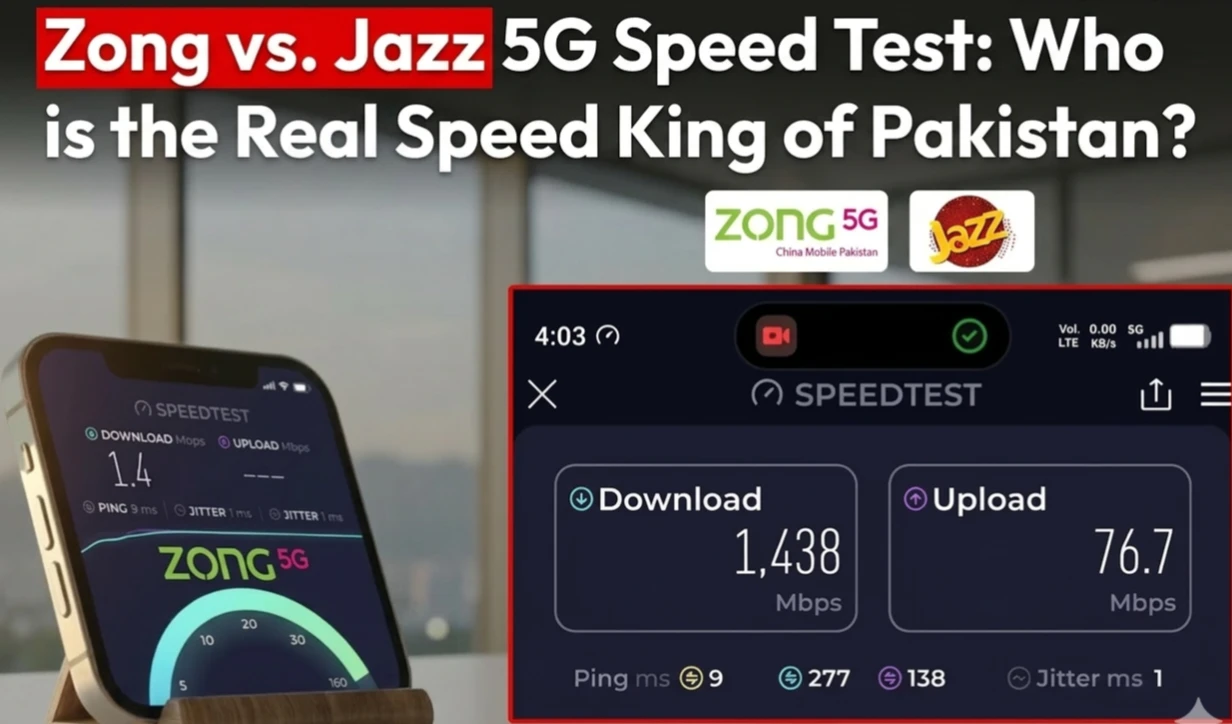
During a pilot test, Zong achieved a peak download speed of 1,438 Mbps. To put that in perspective, that is roughly 14 times faster than a high-end 100 Mbps fiber connection. You could download a 2GB movie in less than 15 seconds.
Zong 5G Trial Highlights:
- Peak Download Speed: 1,438.52 Mbps
- Upload Speed: 76.7 Mbps
- Ping (Latency): 9ms to 12ms
- Location: Blue Area, Islamabad (Experimental Zone)
Zong’s advantage lies in its parent company, China Mobile. They have access to some of the world’s most advanced 5G hardware and “know-how.” By hitting these numbers, Zong is sending a clear message: we have the raw power.

Jazz 5G Strategy: Is Consistency Better Than Peak Speed?
Jazz isn’t sitting quietly. As the network with the largest subscriber base in Pakistan, Jazz’s focus is slightly different. While Zong is chasing record-breaking “hero” numbers, Jazz seems to be focusing on “Massive MIMO” technology. This ensures that even when thousands of people are connected to a single tower, the speed doesn’t drop.
In their 2026 trials, Jazz has consistently hit speeds between 800 Mbps and 1.1 Gbps. While this is lower than Zong’s peak, the “jitter” (the stability of the connection) was reportedly very low.

Jazz 5G Trial Highlights:
- Peak Download Speed: 1,050 Mbps
- Average Stability: High across congested areas.
- Ecosystem: Strong integration with JazzCash and digital services.
Jazz is playing the long game. They want a network that works for everyone, not just people standing directly under a tower in Islamabad.
Deep Dive: The Speed Test Comparison
When we compare these two giants, we have to look at three main pillars: Download Speed, Upload Speed, and Ping.
| Feature | Zong 5G (Trial Data) | Jazz 5G (Trial Data) |
|---|---|---|
| Max Download | 1,438 Mbps | 1,100 Mbps |
| Max Upload | 70 – 80 Mbps | 60 – 75 Mbps |
| Typical Latency | 9ms | 11ms |
| Spectrum Band | 3.5 GHz | 3.5 GHz |
Why Download Speed is a Big Deal
Most users care about download speed because it dictates how fast apps update and how smooth 4K streaming is. Zong currently holds the “bragging rights” here. If you want the absolute fastest file transfer, Zong’s 1.4 Gbps record is hard to beat.
The Upload Gap
Surprisingly, 5G upload speeds in Pakistan aren’t as high as the downloads yet. Both networks are hovering around 60-80 Mbps. While this is plenty for a 4K Zoom call or uploading a TikTok in seconds, it shows that the networks are currently “asymmetric”—optimized more for consuming content than creating it.
Why “Ping” is the Real Game Changer
If you are a PUBG or Valorant player, you know that “Speed” is only half the story. The other half is “Ping” or Latency. This is the time it takes for a signal to go from your phone to the server and back.
In 4G, pings in Pakistan usually range from 40ms to 80ms. In the 5G trials:
- Zong hit a record 9ms.
- Jazz stayed around 11ms.
This is a massive improvement. A 9ms ping feels instantaneous. It removes the “lag” that kills you in competitive games. For the first time, mobile gamers in Pakistan can compete on a level playing field with players in Europe or the US.
What This Means for the Average User
You might be thinking, “Do I really need 1,000 Mbps on my phone?” For daily scrolling, maybe not. But 5G changes things you don’t even think about:
- Crowded Places: Have you ever been to a cricket match at National Stadium or a concert where your internet stops working because too many people are there? 5G solves this. It can handle 10 times more devices per square kilometer than 4G.
- Instant Content: Imagine never seeing a “loading” circle again. 8K video streaming becomes as easy as 360p is today.
- Home Internet: 5G “Fixed Wireless Access” (FWA) could replace your home fiber. You just plug in a 5G router, and you have ultra-fast internet without a technician drilling holes in your wall.
The Challenges: Why We Aren’t All on 5G Yet
Despite the amazing speed tests, there are three hurdles we still face in Pakistan:
1. Handset Availability
Most mid-range phones in Pakistan are still 4G-only. To use Zong or Jazz 5G, you need a 5G-enabled chipset like the Snapdragon 8 Gen series or Dimensity 9000. These are usually found in expensive flagship phones.
2. Infrastructure Costs
Building a 5G network is expensive. 5G signals don’t travel as far as 4G signals. This means companies have to install “small cells” every few hundred meters. This will take time, starting with big cities like Karachi, Lahore, and Islamabad before moving to smaller towns.
3. Battery Drain
Early 5G tests show that 5G uses more battery than 4G. As the networks mature, software updates will help, but for now, 5G users might need to carry a power bank.
Verdict: Who is the Speed King?
As of March 2026, Zong is the “Peak Speed King.” Their 1.4 Gbps trial is the highest verified speed we have seen in the country. They are pushing the limits of what mobile hardware can do.
However, Jazz is the “Stability Contender.” If Jazz can provide 800 Mbps to 40 million people consistently, while Zong provides 1.4 Gbps to only 10 million, the user’s “perceived” king might be Jazz.
The real winner? The Pakistani consumer. Competition between these two giants will drive prices down and quality up.
Frequently Asked Questions (FAQs)
1. When will 5G be available for everyone in Pakistan?
The commercial rollout is expected to begin in major cities by mid-2026. PTA has completed the auction, and networks are now in the final “optimization” phase.
2. Do I need a new SIM card for 5G?
In most cases, your current 4G “USIM” will work with 5G. However, some networks may launch special “5G Ready” SIMs to enable specific high-tier features.
3. Will 5G packages be more expensive than 4G?
Initially, 5G might be sold as a “premium” service. However, because 5G is more efficient at carrying data, the “price per GB” is actually expected to drop over the next two years.
4. Which cities will get 5G first?
The rollout will follow a “Tier-1” approach. Islamabad, Karachi, Lahore, and Multan are top of the list, followed by Sialkot and Faisalabad.
5. Can I use 5G on an iPhone 12 or newer?
Yes, iPhone 12 and above support 5G. Once the network is live, you may receive a carrier settings update from Apple to enable the 5G toggle in your settings.
Final Thoughts
The race between Zong and Jazz is the best thing to happen to Pakistan’s tech sector. While Zong holds the record with its 1,438 Mbps trial, the battle for coverage and affordability is just beginning. Keep an eye on your signal bar—the 5G icon is coming to a phone near you very soon!