
HEC HAT 2026 registration is open. For any student in Pakistan aiming to level up their academic journey with an MS, M.Phil., or Ph.D., one acronym stands between them and their goal: HAT. The Higher Education Aptitude Test is more than just an exam; it is a standardized gateway used by universities nationwide and for prestigious HEC scholarship awards.
Navigating the admission season can be stressful. Between university deadlines and scholarship applications, keeping track of testing requirements is a challenge. This guide breaks down everything you need to know about the 2026 HAT cycle, ensuring you are prepared to secure your seat in your dream program.
Understanding the Higher Education Aptitude Test (HAT)
The Higher Education Commission (HEC), through the Education Testing Council (ETC), organizes this test to maintain a high standard of postgraduate intake. Unlike general entrance exams, the HAT is tailored to your specific academic background.
Why Is This Test Mandatory?
Most public and private sector universities in Pakistan require a valid HAT score for their doctoral and research-based Master’s programs. Additionally, if you are eyeing HEC-funded scholarships (both local and international), this score is often a primary evaluation metric. It ensures that students possess the analytical and verbal skills necessary for advanced research.

Finding Your HAT Category: A Tailored Approach
One of the most common mistakes students make is registering for the wrong test version. The HEC has divided the HAT into five distinct categories. Each one focuses on skills relevant to specific fields of study.
HAT 1: Engineering and Physical Sciences
If your background is in Engineering, Technology, Computer Science, Mathematics, or Physics, this is your category. It places a heavy emphasis on Quantitative Reasoning (40%), testing your mathematical and logical ability.
HAT 2: Management and Business
Business students, including those pursuing an MBA or MS in Management Sciences, fall under HAT 2. Here, the focus shifts slightly toward Analytical Reasoning (40%), reflecting the problem-solving nature of the corporate world.

HAT 3: Arts, Humanities, and Social Sciences
For those in the Arts, Psychology, Law, or Social Sciences, HAT 3 prioritizes Verbal Reasoning (40%). This section evaluates your reading comprehension, vocabulary, and ability to process complex English text.
HAT 4: Life Sciences and Education
This category covers a broad range of disciplines, including Agriculture, Medical Sciences, Media Studies, and Education. Like the Arts category, it focuses 40% of the weight on Verbal Reasoning, balanced with 30% each for analytical and quantitative sections.

HAT-General: For Madrasa Graduates
Specifically designed for students coming from religious education backgrounds (Religious Studies), this version ensures that these graduates have a fair path into mainstream higher education.
Key Dates and Deadlines for 2026
Missing a deadline is the quickest way to delay your degree by six months or a year. The 2026 schedule is tight, so mark your calendars:
- Registration Opening: The portal goes live on March 15, 2026.
- The Final Cut-off: You must submit your application by March 30, 2026.
- The Big Day: The actual test will be conducted on Sunday, April 19, 2026.
Pro-Tip: Don’t wait until March 30th. High traffic on the ETC portal often leads to slow loading times on the final day.
Preparation Strategy: Scoring Above 50
While the passing score is 50 out of 100, simply passing might not be enough for competitive scholarships or top-tier universities. To excel, you need to master three core areas:
1. Verbal Reasoning (English)
This isn’t just about grammar. You need to understand context, identify synonyms/antonyms, and complete sentences logically. Reading daily editorials from reputable news sources can significantly boost your score here.
2. Analytical Reasoning
This section tests your ability to deduce information from a set of facts. It’s about logic puzzles and “if-then” scenarios. Practice with previous GRE or GAT papers is highly effective for this portion.
3. Quantitative Reasoning
Dust off your high school math books. You will encounter questions on algebra, geometry, ratios, and percentages. Speed is key here, so learn mental math shortcuts.
HEC HAT 2026 Advertisement
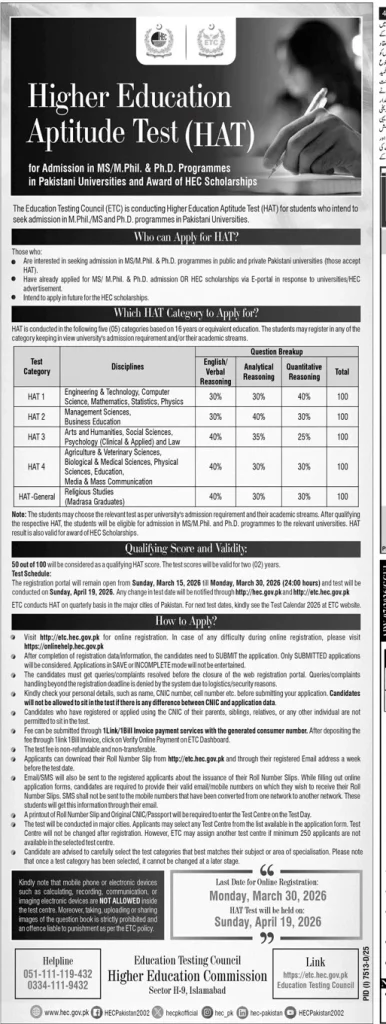
Step-by-Step Registration Guide
The HEC has moved to a completely digital system through the ETC portal. Follow these steps to ensure a smooth registration:
Account Creation
Visit the official ETC website. If you haven’t used it before, you will need to create a profile using your CNIC. Ensure all personal details match your official documents exactly.
The Application Form
Once logged in, select the “Higher Education Aptitude Test” option. You will be asked to choose your category. Refer to the table above to make sure you pick the right one for your degree.
Paying the Fee
The payment system is now integrated through 1Link and 1Bill. Once you generate your application, you will get a consumer number. You can pay this via ATM, mobile banking, or internet banking. Note: Your application is not complete until you click “Submit” after payment verification.
What to Expect on Test Day
Preparation doesn’t end with studying; it includes knowing the rules of the examination hall.
- Roll Number Slips: These are usually available for download one week before the test. You will also receive an SMS or email notification.
- Mandatory Documents: You must bring a printed copy of your roll number slip and your Original CNIC or Passport. Without these, entry is strictly prohibited.
- Electronic Ban: Calculators, mobile phones, and smartwatches are not allowed. You will have to rely on your brain and the provided rough sheets.
The Road Ahead: Validity and Results
Once you take the test, your score is valid for two years. This is great news for students who might not find the perfect program immediately; you can use the same score for multiple admission cycles within that window.
The HAT is conducted quarterly. If you aren’t happy with your April score, you can typically try again in the next cycle, though you will have to pay the registration fee again.
Frequently Asked Questions (FAQs)
1. Can I change my test category after submitting the form?
No. Once you have submitted your application and paid the fee, the test category cannot be changed. Double-check your discipline requirements before hitting submit.
2. Is the HAT score valid for international scholarships?
Yes, many HEC-sponsored overseas scholarships use the HAT score as a primary filtering tool for candidates.
3. What happens if I forget my original CNIC on test day?
Entry is generally denied without original identification. Photocopies or digital copies on your phone are not accepted. Ensure your ID is valid and not expired.
4. How many times a year is the HAT conducted?
The Education Testing Council usually conducts the HAT on a quarterly basis (four times a year) in major cities across Pakistan.