The people of Pakistan have finally received a significant breath of fresh air. In a move that caught many by surprise due to its scale, Prime Minister Muhammad Shehbaz Sharif has officially approved a massive reduction in High-Speed Diesel (HSD) prices.
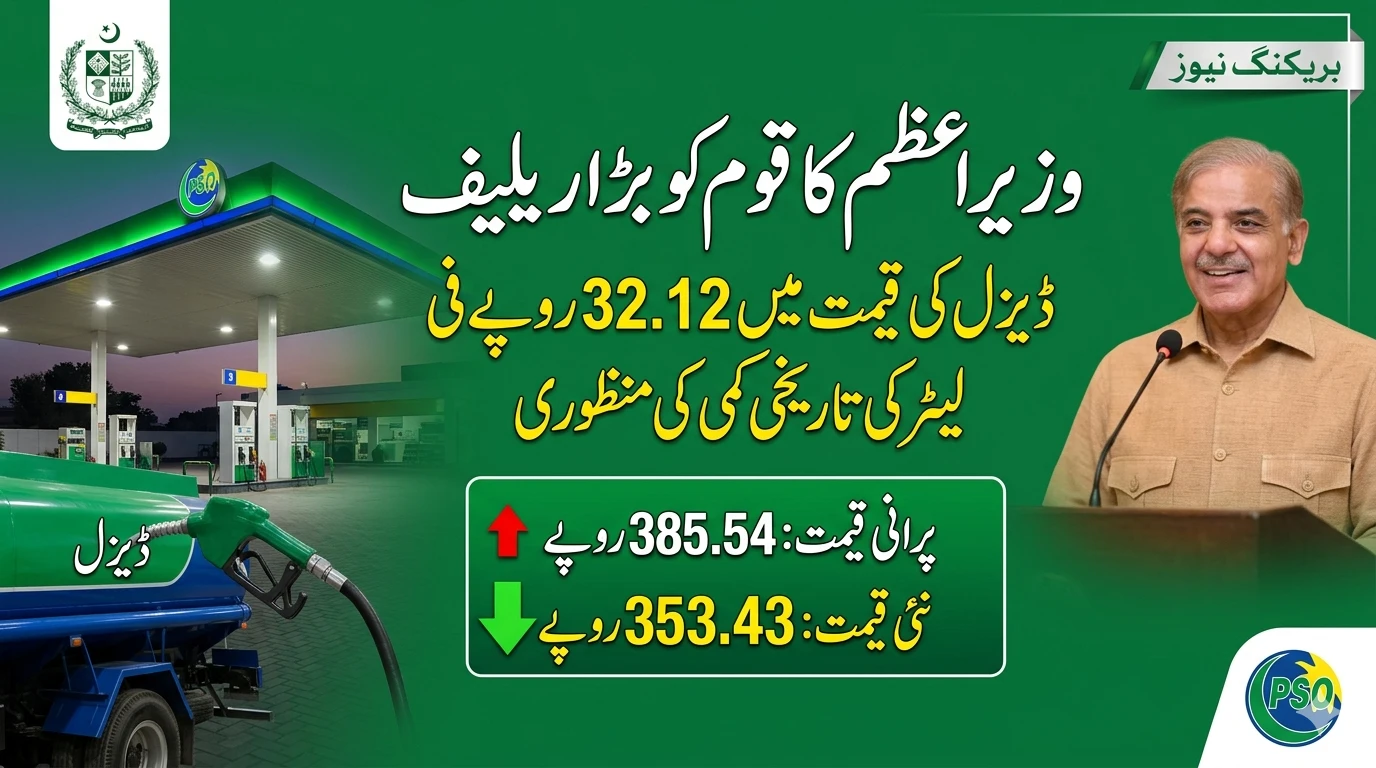
Effective immediately, the cost of diesel has dropped by over 32 rupees per liter. This isn’t just a minor adjustment; it is one of the largest single-day price drops in recent months. For a nation struggling with high inflation and rising transport costs, this news is being hailed as a major victory for the common man.
In this article, we will break down the new pricing structure, why this decision was made, and what it means for your wallet, your business, and the national economy.
The Big Breakdown: Old vs. New Diesel Prices
Understanding the numbers is the first step to seeing the impact of this relief. The Prime Minister’s office confirmed that the reduction was calculated to pass on the full benefit of international market shifts and currency stability to the public.

Below is the official price comparison following the April 18, 2026, notification:
| Fuel Type | Previous Price (Rs) | Reduction (Rs) | New Price (Rs) |
|---|---|---|---|
| High-Speed Diesel (HSD) | 385.54 | 32.12 | 353.43 |
This drop brings the price down from a staggering 385.54 rupees to a much more manageable 353.43 rupees. When you fill up a standard 50-liter tank, you are now saving over 1,600 rupees per trip.
Why Did the Government Slash Prices Now?
Government decisions regarding fuel are usually a mix of global economics and local politics. According to sources within the Ministry of Finance and the Prime Minister’s Secretariat, two main factors drove this Rs 32.12 cut.

First, global crude oil prices have seen a period of relative cooling. As international supply chains stabilized, the cost of importing refined products like HSD decreased. Second, the Pakistani Rupee (PKR) has shown remarkable resilience against the US Dollar in the last few weeks.
Prime Minister Shehbaz Sharif emphasized that the government’s priority is “Relief for the People.” He stated that as soon as the fiscal space became available, the decision was made to slash rates rather than increase tax revenue.
Immediate Impact on Transportation and Logistics
Diesel is the lifeblood of Pakistan’s transport industry. Unlike petrol, which is mostly used by private cars and bikes, diesel powers the heavy-duty trucks and buses that move goods and people across the country.
Lower Commuter Fares
With a 32-rupee drop, transport unions are already under pressure to reduce inter-city bus fares. If you travel between cities like Lahore, Islamabad, or Karachi, you should expect a notification regarding lower ticket prices in the coming days.
Goods Transport Costs
The cost of moving sugar, wheat, and cement depends entirely on diesel. When transporters pay less at the pump, the “per-kg” cost of moving goods drops. This is the first step in breaking the cycle of “cost-push” inflation that has made daily life difficult for many families.
A Massive Win for the Agriculture Sector
For the farmers in the heartlands of Punjab and Sindh, diesel is more than just fuel—it is a tool for survival. From running tractors for land preparation to powering tube wells for irrigation, the farming community is the biggest consumer of HSD.
This reduction comes at a critical time for the agricultural calendar. Lowering the cost of production for farmers means:
- Lower Food Prices: When it costs less to grow crops, the final price at the “Sabzi Mandi” eventually stabilizes.
- Increased Profitability: Small-scale farmers who were struggling with high input costs will now have more capital to invest back into better seeds and fertilizers.
Will This Help Reduce Inflation?
Inflation in Pakistan is often tied directly to the “Fuel Price Index.” When fuel goes up, everything else follows. Conversely, when fuel prices take a hit as large as 32 rupees, it sends a psychological and economic signal to the market.
While prices at the grocery store don’t drop overnight, the reduction in transport overheads removes the most common excuse used by wholesalers to hike prices. The Prime Minister has reportedly directed provincial administrations to ensure that the benefits of this diesel cut are strictly passed down to the retail level.
Looking at the Global Context
It is important to remember that Pakistan is an oil-importing nation. Our local prices are a reflection of the “Platts” indices and the exchange rate.
While the current relief is substantial, experts suggest that the government is also keeping a close eye on the Middle East and global supply routes. For now, the stability in the global market has provided a “window of opportunity” that the Pakistani government has successfully utilized to favor its citizens.
How the Public is Reacting
Early reports from fuel stations across major cities show a sense of relief among drivers. Truck drivers, who often have to manage tight margins, have welcomed the move.
”We were paying nearly 400 rupees for a liter just a while ago,” says Ahmed, a long-haul truck driver in Talagang. “This 32-rupee cut means I can actually take some money home to my family instead of giving it all to the fuel tank.”
What to Expect in the Coming Weeks?
While the diesel price is fixed for the next fortnight, the secondary effects will take a few weeks to fully manifest. We expect to see:
- Official notifications from provincial transport authorities regarding fare revisions.
- A slight cooling in the Consumer Price Index (CPI).
- Potential adjustments in electricity bills (Fuel Price Adjustment), as some power plants still rely on diesel-based generators.
Summary of the New Fuel Policy
The Shehbaz Sharif administration seems focused on a “People-First” economic strategy as we head further into 2026. By choosing to provide a massive Rs 32.12 relief on HSD, the government is targeting the root cause of high transport and food costs.
As a consumer, your focus should now be on ensuring that the service providers you use—whether they are transporters or vegetable vendors—are reflecting this change in their prices.
Frequently Asked Questions (FAQs)
1. What is the new price of diesel in Pakistan as of April 18, 2026?
The new price of High-Speed Diesel (HSD) is Rs 353.43 per liter, following a reduction of Rs 32.12.
2. Why did the government reduce the diesel price so significantly?
The reduction is due to a combination of lower international oil prices, a stable Pakistani Rupee, and the government’s policy to provide direct relief to the public.
3. When does this new price come into effect?
The new prices are effective immediately from the time of the notification on April 18, 2026.
4. Will petrol prices also decrease?
While this specific notification focused on the massive relief for diesel (HSD), petrol prices are reviewed simultaneously. You should check the latest OGRA notification for specific updates on Motor Spirit (Petrol).
5. How will this affect the prices of daily groceries?
Since diesel is used for transporting food and essential goods, a decrease in fuel costs reduces the overhead for wholesalers, which should lead to more stable or lower prices for groceries over the next few weeks.
For the latest updates on fuel prices, market trends, and government notifications, stay tuned to www.maryamkobatain.pk—your trusted source for timely and accurate news in Pakistan.