Education in Punjab has just taken a massive leap into the future. For the first time ever, the province has successfully completed a 100% machine-marked assessment for Grade 8 students. This isn’t just about grades; it’s about using modern technology to make sure every student gets a fair and fast result.
The results for 2026 are officially out, and the numbers tell an incredible story of growth, hard work, and technological success. With nearly one million students sitting for these exams, the scale of this achievement is unlike anything we have seen before in Pakistan’s educational history.
A New Era for Exams in Punjab
In the past, marking hundreds of thousands of exam papers by hand took months. It also left room for human error. This year, under the leadership of the Punjab government and CM Maryam Nawaz, the system shifted to an AI-enabled process.
Using the PECTAA (Punjab Education Exam Management System), the province managed to grade papers with 100% accuracy using machines. This means that from the moment a student finished their paper to the day the results were announced, the process was driven by data and speed.

This shift isn’t just about being “high-tech.” It is about transparency. Parents and students can now trust that the marks awarded are based strictly on what was written on the paper, without any external bias.
Gender Enrollment & Performance
| Category | Enrollment Count | Enrollment % | Pass Rate (Above 33%) |
|---|---|---|---|
| Female | 541,638 | 54% | 92% |
| Male | 453,013 | 46% | 83% |
| Overall | 994,651 | 100% | 88% |
Grade Distribution (Cumulative Out of 400)
Criteria: Cumulative score ≥ 132 marks
| Grade | Range | Count | Percentage |
|---|---|---|---|
| A1 | 320 – 400 | 3,622 | 0% |
| A | 280 – 319 | 41,182 | 5% |
| B | 240 – 279 | 139,662 | 16% |
| C | 200 – 239 | 234,160 | 26% |
| D | 160 – 199 | 243,639 | 27% |
| E | 132 – 159 | 120,118 | 13% |
Breaking Down the Numbers: 1 Million Students and a Record Success
The sheer volume of the Grade 8 Assessment 2026 is staggering. Nearly one million students across the province participated in this exercise. Despite the massive number of participants, the results show a significant improvement in academic performance.

The Record-Breaking Pass Rate
The overall pass rate for 2026 stands at 88%. This is the highest pass percentage ever recorded for the Grade 8 assessment in Punjab. It suggests that both the teaching quality and the student’s engagement with the new assessment format are moving in the right direction.
The Gender Gap: Girls Take the Lead
When we look closer at the data, a very clear trend emerges. While both boys and girls performed well, the girls have taken a significant lead:

- Girls’ Pass Rate: 92%
- Boys’ Pass Rate: 83%
This 9% gap highlights the dedication of female students across Punjab. It also shows that the efforts to promote girls’ education in both urban and rural areas are yielding real results.
Punjab Grade 8 Assessment 2026: AI-Enabled Results Reveal Record 88% Pass Rate
The Magic of Machine Marking: How AI Changed the Game
You might wonder, “How does a machine mark an exam?” The PECTAA system uses advanced optical recognition and AI algorithms to read student responses. This year’s School-Based Assessment (SBA) was designed to be compatible with this technology.
Why This Matters for Students
- Speed: Results that used to take an entire season to process are now ready in record time.
- Accuracy: Machines don’t get tired. They mark the millionth paper with the same level of focus as the first one.
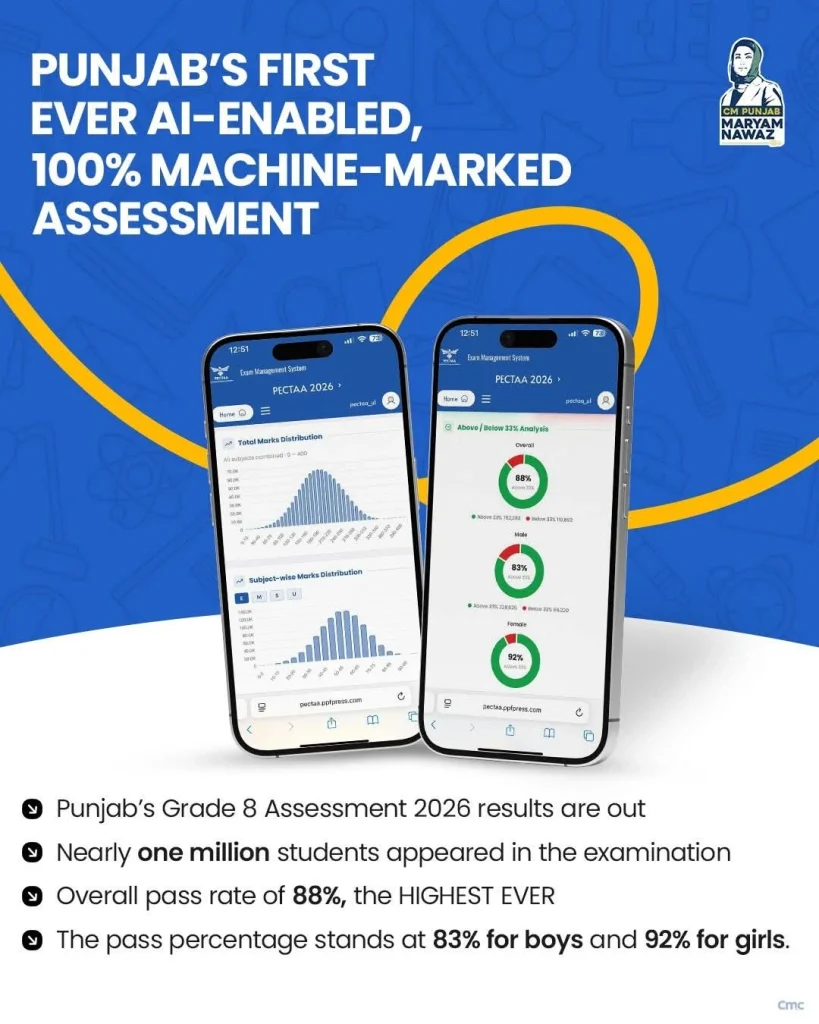
- Detailed Feedback: As seen in the digital dashboards, the system provides a “Total Marks Distribution” and “Subject-wise Analysis.” This helps schools see exactly where students are struggling—whether it’s in Math, Science, or Urdu.
Fairness for All
In a manual system, different teachers might mark slightly differently. One might be “strict” while another is “lenient.” AI marking removes this inconsistency. Every student in Punjab, whether they are in a high-end school in Lahore or a small village in Rajanpur, is judged by the exact same digital standard.
A Closer Look at the Performance Analysis
The 2026 assessment didn’t just give a “pass” or “fail” grade. The new digital system provides a deep dive into how students are actually learning.
The data shows a “Normal Distribution” or a bell curve in the marks. This means most students are performing in the middle range (around 200–300 marks out of 400), which is a sign of a healthy and balanced examination system. It proves the exam wasn’t too easy, nor was it unfairly difficult.
The “Above/Below 33% Analysis” is another vital tool. By identifying that 88% of students scored above the 33% threshold, the government can now focus its resources on the 12% who are falling behind. This targeted approach is much better than guessing which districts need help.
How to Understand Your PECTAA 2026 Result
If you are a parent or student looking at the new digital result format, you will notice several sections on the dashboard. Here is how to read them:
- Total Marks Distribution: This shows you where your score sits compared to the rest of the million students.
- Subject-wise Tabs: You can click through subjects like English (E), Math (M), Science (S), and Urdu (U) to see specific performance.
- Percentage Analysis: This tells you if you are in the top tier of students or if you need to improve in certain areas to stay above the 33% mark.
What This Means for the Future of Education in Punjab
The success of the Grade 8 Assessment 2026 is a pilot for what’s coming next. We can expect this AI-driven model to be expanded to other grade levels soon.
By removing the “fear” of biased marking and replacing it with a transparent, machine-led system, Punjab is preparing its students for a digital world. Students are learning that their hard work is the only thing that determines their success.
Furthermore, the data collected from this million-student assessment will be used to train teachers. If the AI shows that 40% of students struggled with a specific Math concept, the education department can update the curriculum or provide extra training to teachers in that specific area.
Tips for Students Moving to Grade 9
Passing the Grade 8 assessment with such high marks is a great achievement, but Grade 9 brings new challenges. Here are a few tips:
- Don’t Stop the Momentum: Use the confidence from the 88% pass rate to dive into your elective subjects.
- Embrace Technology: Since your exams are becoming more digital, get comfortable using online learning tools and digital practice tests.
- Focus on Weak Spots: Look at your PECTAA subject-wise marks. If your Science score was lower than your Urdu score, plan to spend an extra hour on Science each week.
Final Thoughts
The Punjab Grade 8 Assessment 2026 has set a new benchmark for the entire country. By combining the hard work of nearly one million students with the precision of AI technology, the province has proven that it is ready for the future.
Congratulations to all the students, especially the girls who achieved a record 92% pass rate! Your hard work is the foundation of a brighter Punjab.
Frequently Asked Questions (FAQs)
1. What does “AI-Enabled Marking” mean for my child?
It means your child’s exam was scanned and graded by a computer system designed to be 100% fair. It eliminates human error and ensures that every student is graded on the same scale, regardless of where they live.
2. Why is the pass rate higher this year?
The 88% pass rate is a result of better-structured assessments (SBA), improved digital monitoring of schools, and students becoming more familiar with the examination format. The AI system also ensures that no marks are “lost” due to manual counting errors.
3. How can I check the Grade 8 2026 result?
Results are available through the official PECTAA portal. You can usually check by entering the student’s roll number or through the school’s registered dashboard.
4. What happens if a student scored below 33%?
Students who scored below 33% are considered to be below the passing threshold. The government uses this data to identify schools that need extra support and “remedial” classes to help those students catch up.
5. Why did girls perform better than boys in this assessment?
Data shows that girls in Punjab have been consistently showing higher enrollment and attendance rates in recent years. Their 92% pass rate reflects a strong commitment to learning and the success of various “Khadim-e-Punjab” and CM initiatives aimed at female education.