The Government of Pakistan has recently introduced a significant austerity plan aimed at managing national expenses. This new policy focuses on the higher management of various state institutions and autonomous bodies. If you are looking for clear details on how these salary cuts work, who is affected, and where the money goes, this guide breaks it all down in simple terms.
Understanding the 2026 Austerity Measures
Economic management often requires tough decisions, and the Cabinet Division’s latest notification is a clear example. The Prime Minister has directed a temporary salary reduction for the top tier of management in state-owned entities. This isn’t a permanent change, but a two-month initiative designed to boost the “Prime Minister’s Austerity Fund 2026.”
The main goal here is fuel conservation and general cost-cutting across the board. By targeting the highest earners in the public sector, the government aims to lead by example in financial discipline.
Who is Affected by These Salary Cuts?
It is important to note that these deductions do not apply to every government employee. The policy specifically targets the “higher management” level. This includes:

- Chief Executive Officers (CEOs) of various authorities.
- Executive Directors and Directors of state-owned companies.
- Senior Managers in regulatory bodies.
- Government Nominees serving on various boards.
Whether the institution is a statutory body, an autonomous authority, or a state-owned enterprise (SOE), the top-level staff will see a portion of their gross pay deducted for the next 60 days.
Breakdown of Salary Deduction Percentages
The government has created a tiered system. This means the more an officer earns, the higher the percentage they contribute to the austerity fund. This “progressive” approach ensures that the burden is distributed based on the individual’s earning capacity.
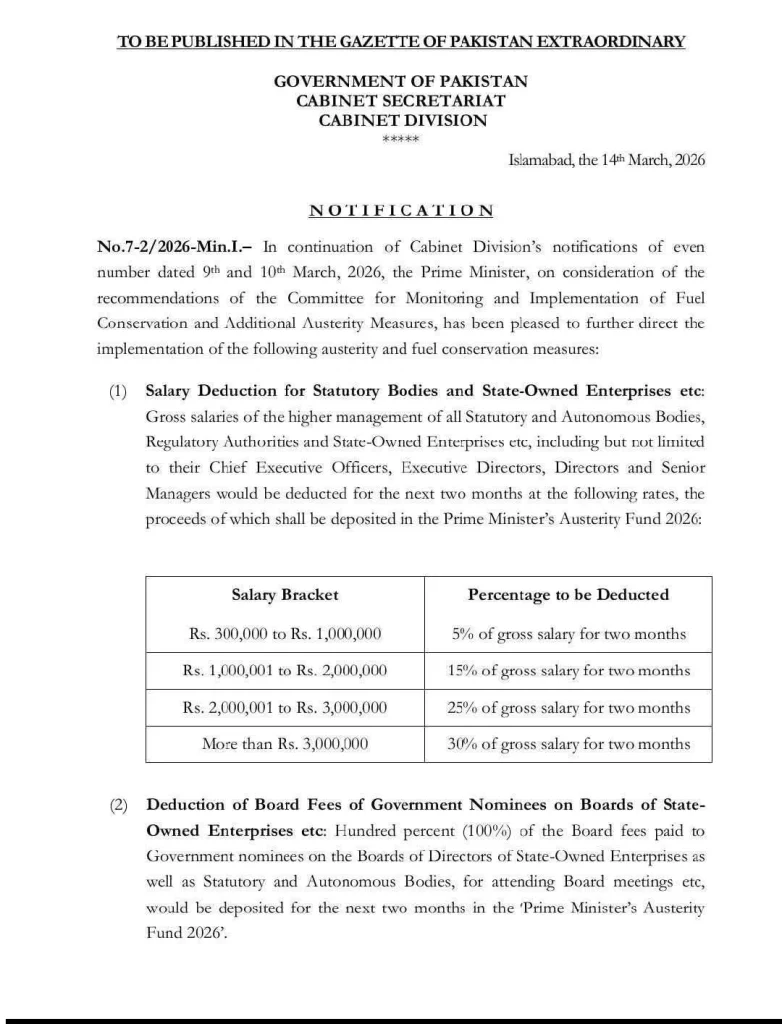
The Current Deduction Table
| Monthly Gross Salary Range | Percentage to be Deducted |
|---|---|
| Rs. 300,000 to Rs. 1,000,000 | 5% Deduction |
| Rs. 1,000,001 to Rs. 2,000,000 | 15% Deduction |
| Rs. 2,000,001 to Rs. 3,000,000 | 25% Deduction |
| Above Rs. 3,000,000 | 30% Deduction |
These deductions apply to the gross salary, which is the total amount before any other taxes or benefits are taken out.

New Salary Deduction Rules for Pakistan Government Officers 2026 Notification
Special Rules for Board Meeting Fees
In addition to monthly salaries, many high-ranking officials and government nominees receive “Board Fees” for attending meetings of various corporations. Under the new 2026 notification, this has changed significantly for a short period.
For the next two months, 100% of these board fees will be deducted. Instead of going to the individual, the entire amount will be deposited directly into the Prime Minister’s Austerity Fund. This applies to everyone nominated by the government to sit on the boards of directors for both statutory and autonomous bodies.

What is the Prime Minister’s Austerity Fund 2026?
You might wonder what happens to the money collected from these cuts. The proceeds are not just disappearing into the general budget. They are being funneled into a specific account called the Prime Minister’s Austerity Fund 2026.
The fund is intended to support the country’s broader goals of:
- Fuel Conservation: Reducing the national bill for imported fuel.
- Financial Stability: Providing a buffer for essential public services.
- National Savings: Encouraging a culture of simplicity within government offices.
The Impact on State-Owned Enterprises (SOEs)
State-owned enterprises are companies owned by the government that provide essential services like power, water, or transport. By implementing these cuts in SOEs, the government is trying to make these organizations more efficient.
Reducing the take-home pay of top executives for a short window helps signal to the public that the leadership is willing to share the economic challenges faced by the common people.
How Long Will These Measures Last?
Based on the official notification from the Cabinet Secretariat, these specific salary and fee deductions are set for a duration of two months. While the policy is temporary, it reflects a larger strategy of monitoring and implementation by the Committee for Austerity.
If the economic situation requires further action, the government may extend or modify these rules, but for now, the timeline is strictly for a two-month period starting from the date of the notification in March 2026.
Why Readability Matters in Government News
Often, official notifications use very hard words that confuse the public. It is important for every citizen to understand how public funds are managed. By breaking down the technical language of the “Gazette of Pakistan” into simple English, we ensure that everyone—from students to professionals—knows exactly what is happening in the country’s leadership.
Frequently Asked Questions (FAQs)
1. Does this salary cut affect lower-scale government employees?
No. The current notification only applies to higher management and senior officials earning above Rs. 300,000 per month. Lower-scale staff and common workers are not affected.
2. Is this a permanent reduction in pay?
No, this is a temporary measure. The notification specifies that the deductions will only take place for the next two months.
3. Where is the deducted money deposited?
The money is deposited into the “Prime Minister’s Austerity Fund 2026” to help with national savings and fuel conservation.
4. Does this include private sector employees?
No. This rule is strictly for Statutory Bodies, Autonomous Bodies, Regulatory Authorities, and State-Owned Enterprises (SOEs) under the Government of Pakistan.
5. What happens to the fees for attending board meetings?
For the next two months, 100% of the fees paid to government nominees for attending board meetings will be deducted and sent to the austerity fund.