Have you ever been in the middle of an important video call or trying to upload a video, only to have your signal drop or your speeds crawl to a halt? For many mobile users in Pakistan, this has been a daily struggle. As more people get online, the “airwaves” that carry our data become crowded.
Recently, Jazz, the country’s largest mobile operator, took a massive step to fix this problem. By investing over $239 million into new radio spectrum, the company isn’t just buying numbers on a page; they are building a bigger, faster highway for your digital life.
This move is a clear signal that the future of Pakistan’s internet is about to get a lot more reliable. Let’s break down what this means for you, the economy, and the technology in your pocket.
What Exactly is “Spectrum” and Why Should You Care?
To understand why this news matters, we first need to talk about what spectrum actually is. Think of spectrum as the invisible “lanes” in the air that carry signals from a cell tower to your phone.

Imagine a two-lane highway. If only a few cars are driving on it, everything moves fast. But if thousands of cars try to use those same two lanes at once, you get a traffic jam. In the world of mobile phones, a traffic jam means slow download speeds, “lag” in gaming, and dropped calls.
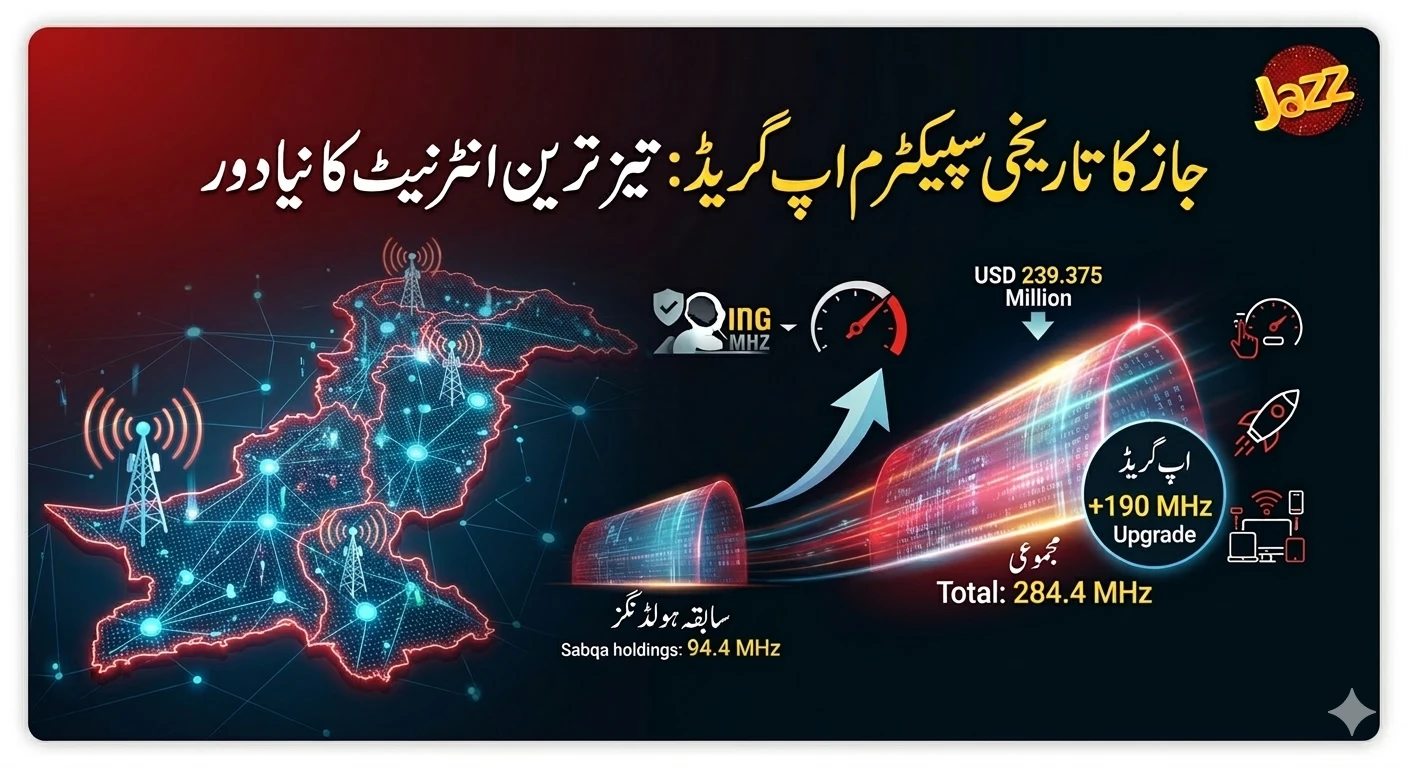
By adding 190 MHz of additional spectrum, Jazz is essentially turning that two-lane highway into a twelve-lane superhighway.
| Feature | Details |
|---|---|
| Company | Jazz (Pakistan) |
| Acquisition Type | Radio Spectrum (via auction) |
| Additional Spectrum Secured | 190 MHz |
| Total Cost | USD 239.375 Million |
| Previous Spectrum Holdings | 94.4 MHz |
| New Total Spectrum Holdings | 284.4 MHz |
| Primary Goal | Strengthening Pakistan’s digital infrastructure |
A $239 Million Bet on Pakistan’s Digital Future
Investing nearly $240 million USD is no small feat. It shows a deep level of confidence in the Pakistani market. This isn’t just a short-term fix; it is a long-term strategy to ensure that as the country moves toward a more digital-first economy, the infrastructure is ready to support it.

This investment flows directly into the government’s “Digital Pakistan” vision. When a major player like Jazz puts this much capital into the local infrastructure, it encourages other sectors—like e-commerce, fintech, and education technology—to grow alongside it. You can’t have a digital revolution if the foundation is shaky.
How This Changes Your Daily Experience
So, what does this actually look like when you wake up and check your phone? The benefits of this spectrum boost touch almost every part of your mobile experience.

1. Faster Download and Upload Speeds
The most immediate change is speed. With more bandwidth available, your phone can pull data from the towers much more efficiently. Whether you are downloading a heavy file for work or posting a high-resolution Reel on Instagram, the process should feel much snappier.
2. Better Performance in Crowded Areas
Have you ever noticed that your internet stops working at a concert, a cricket match, or a busy marketplace? That is because too many phones are fighting for the same small slice of spectrum. By tripling their holdings, Jazz is making it much easier for the network to stay strong even when thousands of people are using it in the same square mile.
3. Improved Indoor Coverage
Certain types of spectrum are better at “penetrating” walls and buildings. This massive acquisition allows the provider to optimize which frequencies they use for different areas. This should lead to fewer “dead zones” inside your home or office.
4. Reduced Latency for Gamers
For those who play games like PUBG or Free Fire, “ping” is everything. High latency (lag) happens when the network is congested. With a wider data highway, your commands reach the server faster, giving you a smoother, more competitive gaming experience.
Paving the Way for 5G in Pakistan
While we are currently living in a 4G world, the talk of the town is 5G. But you can’t just flip a switch and have 5G. It requires a massive amount of spectrum to function correctly.
By securing this 190 MHz now, Jazz is effectively laying the groundwork for the 5G rollout. This spectrum acts as the “backbone” that will eventually support the ultra-high speeds and low latency that 5G promises. It is a “future-proofing” move that ensures Pakistan won’t be left behind as the rest of the world moves into the next generation of connectivity.
The Economic Impact: More Than Just Faster Apps
It is easy to think of this as just a “telecom story,” but the ripples go much further. High-speed internet is the lifeblood of the modern economy.
- Freelancers: Pakistan has one of the largest freelance populations in the world. For someone in a small city or a rural area, a stable mobile connection is their link to international clients.
- Small Businesses: From “Instagram shops” to local delivery services, small businesses rely on WhatsApp and social media to find customers. A better network means they never miss an order.
- Education: Remote learning has become a necessity for many. Higher capacity means students can attend video lectures without the video constantly buffering.
By strengthening the digital infrastructure, this investment is indirectly supporting thousands of jobs across the country.
Overcoming the Digital Divide
One of the biggest challenges in Pakistan is the gap between big cities and rural villages. Often, rural areas get the “leftovers” of network capacity because the big cities consume so much of it.
With a total of 284.4 MHz, Jazz now has enough capacity to go around. This allows them to expand their high-speed services into more remote areas without sacrificing the quality of service in cities like Karachi, Lahore, or Islamabad. It is a step toward making sure every Pakistani, regardless of where they live, has a fair shot at the digital world.
The Role of the PTA and Fair Competition
The Pakistan Telecommunication Authority (PTA) manages these auctions to ensure that the country’s airwaves are used efficiently. By holding these auctions, the government generates revenue while also forcing mobile operators to upgrade their tech.
When one company makes a move this big, it often pushes others to follow suit. This competition is great for the consumer. It leads to better packages, more innovative services, and a constant drive to improve the network.
Final Thoughts: A Connected Tomorrow
The acquisition of 190 MHz of spectrum for $239.375 million is a landmark moment for Jazz. It represents a shift from “just getting by” to “leading the way.” For the average user, it means the “Loading…” circle will appear less often, and the world will feel a little more connected.
As we look toward the next few years, this investment will be remembered as the moment the digital highway in Pakistan finally caught up with the speed of its people’s ambitions.
Frequently Asked Questions
1. Will my current phone work with this new spectrum?
Yes. This upgrade happens at the tower level. Your phone will automatically benefit from the increased capacity and reduced congestion without you needing to change any settings or buy a new device.
2. Does more spectrum mean my battery life will improve?
Indirectly, yes. When a network is congested or the signal is weak, your phone has to work harder (and use more power) to stay connected and send data. A stronger, more efficient network can actually help your battery last a bit longer.
3. Will this make my monthly bill more expensive?
Spectrum auctions are a massive cost for companies, but they are usually seen as long-term investments. While prices are always subject to change due to inflation, the primary goal of buying spectrum is to attract more customers by offering a better experience, not necessarily to hike prices immediately.
4. When will I start noticing the difference in my internet speed?
The rollout of new spectrum usually happens in phases as the company integrates the new frequencies into their existing cell towers. Many users may already be seeing improvements in areas where the hardware has been updated.
5. Is this the same thing as 5G?
Not exactly, but it’s a prerequisite. Think of this as building a bigger airport. You can still land your current planes (4G) there and they will have more room to move, but the bigger airport is also exactly what you need when the new, faster jets (5G) eventually arrive.
p