The FIFA World Cup is the biggest sporting event on the planet. It is a time when nations usually put aside their differences to compete on the grass. However, the 2026 World Cup is already making headlines for reasons that have nothing to do with goals or trophies.
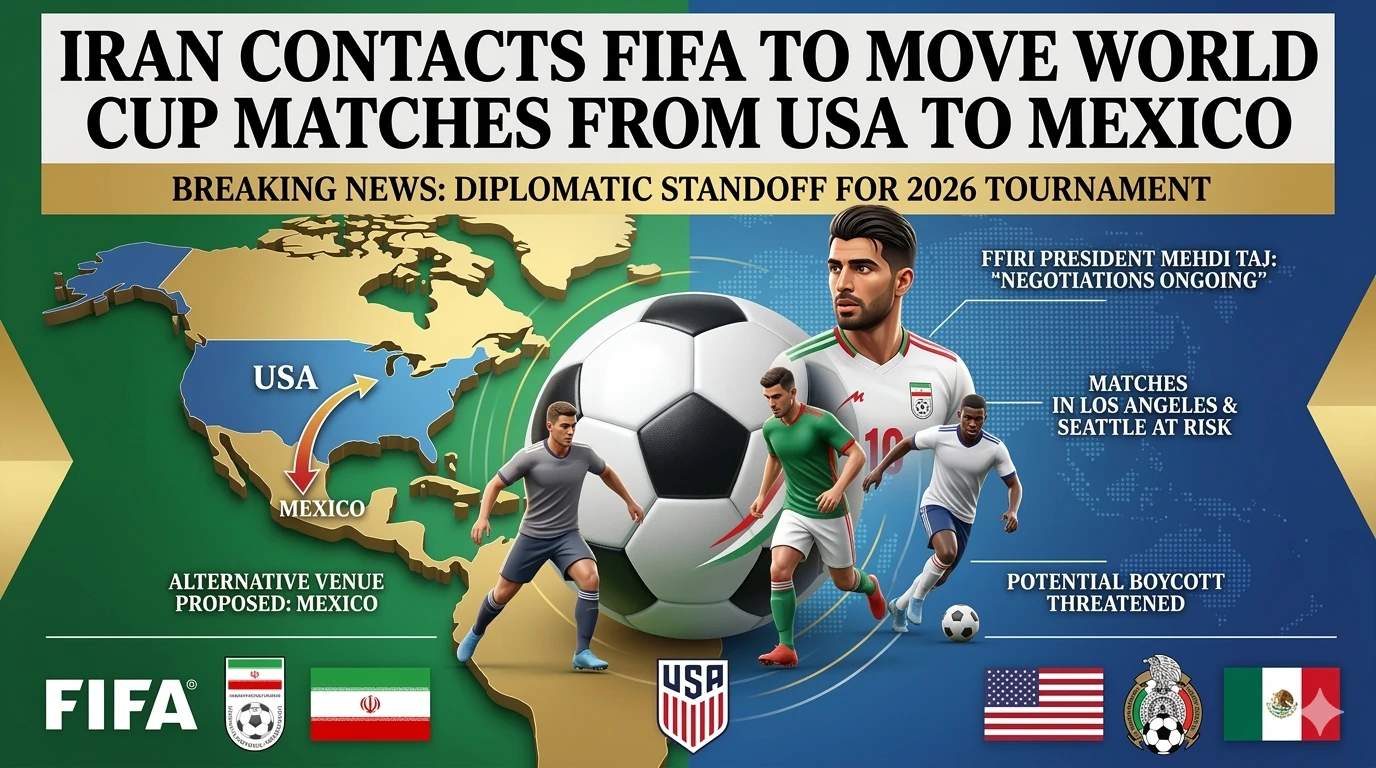
In a surprising turn of events, Iran has officially asked FIFA to change the location of its scheduled matches. While the tournament is being hosted by three countries—the United States, Canada, and Mexico—Iran is refusing to play on American soil. Instead, they are pushing for their games to be moved entirely to Mexico.
This developing story has sent shockwaves through the international football community. It raises a huge question: Can sports remain separate from global politics?
The Core of the Controversy: Iran’s Official Stance
According to recent reports from Al Jazeera, the Iranian Football Federation has taken a firm stand. They have formally contacted FIFA to discuss a “venue swap.” The logic from the Iranian side is simple but heavy with political weight. They do not want their national team to enter the United States.

Mehdi Taj, the President of the Iranian Football Federation, has been very clear about this. He stated that negotiations are currently happening with FIFA officials. He emphasized that the Iranian team will not travel to the USA under any circumstances.
For Iran, this isn’t just about a game. It is about a national policy. By suggesting Mexico as an alternative, they are trying to find a loophole in the co-hosting agreement that allows them to participate without breaking their political stance.
Why Mexico? The Proposed Alternative
Mexico is one of the three host nations for 2026. It is a country with a rich football history, having hosted the World Cup twice before. Iran sees Mexico as a more “neutral” ground.

Logistically, Mexico already has the stadiums and the infrastructure ready for the World Cup. Iran’s proposal suggests that instead of playing in American cities, they could be placed in Mexican host cities like Mexico City, Guadalajara, or Monterrey.
From Iran’s perspective, this solves two problems:

- It avoids the political tension of playing in the United States.
- It prevents the team from being completely disqualified for not showing up.
The Scheduled Cities: Los Angeles and Seattle
As the schedule currently stands, Iran is supposed to play its group-stage matches in Los Angeles and Seattle. These are two massive hubs for football in the United States.
Los Angeles, in particular, was expected to be a highlight for the Iranian team. The city is home to one of the largest Iranian populations outside of Iran. Many expected the atmosphere to be electric, with thousands of local fans cheering for the “Team Melli.”
However, the Iranian government has different priorities. They view the visit as a diplomatic risk. If the matches remain in these cities and Iran refuses to go, the seats will stay empty, and the tournament will face a major crisis.
The Threat of a Total Boycott
The most serious part of this story is the threat of a complete boycott. Iran’s Minister of Sports has already made it clear that if FIFA does not accommodate their request, they may not play at all.
A boycott would be a disaster for several reasons:
- Financial Loss: FIFA and its sponsors lose millions in broadcasting and ticket revenue.
- Tournament Integrity: The group stages would be uneven, and the competitive balance would be ruined.
- Athlete Sacrifice: The players, who have worked their whole lives to reach the World Cup, would lose their chance to compete on the world stage.
If Iran pulls out, it would be the first major political boycott of a World Cup in decades. FIFA is now in a position where they must choose between sticking to their schedule or making a special exception to keep a major team in the competition.
FIFA’s Dilemma: Regulations vs. Diplomacy
FIFA usually tries to stay out of politics. Their motto is “Living Football,” and they pride themselves on being a neutral organization. But the 2026 World Cup is unique because of the shared hosting.
Usually, when a country qualifies, they agree to play wherever the host tells them. By signing the host agreement, the USA, Canada, and Mexico promised to provide visas and security for all qualified teams.
If FIFA allows Iran to move its matches, other countries might ask for similar changes in the future based on their own political views. This could create a “snowball effect” where the tournament schedule becomes impossible to manage.
History of Iran-USA on the Pitch
This isn’t the first time these two nations have met in a football context. Their history is actually quite famous:
- 1998 World Cup: Iran and the USA played in France. It was called the “most politically charged match in history.” Surprisingly, the players were very friendly, taking group photos together. Iran won 2-1.
- 2022 World Cup: They met again in Qatar. It was a winner-takes-all game for the knockout rounds. The USA won 1-0 in a very intense but professional match.
The difference in 2026 is the location. Playing in a third-party country like France or Qatar is one thing. Playing inside the United States is something the Iranian leadership is currently unwilling to do.
The Logistics of a Last-Minute Change
Can a World Cup match actually be moved? Theoretically, yes. Practically, it is a nightmare.
- Security: Thousands of police and security staff are already assigned to LA and Seattle for those dates.
- Fans: Fans from all over the world have already booked flights and hotels in the USA to see these games. A move to Mexico would leave them stranded and out of money.
- Broadcasting: TV schedules are set years in advance. Moving a game to a different time zone or stadium can mess up global advertising deals.
The Impact on the Fans
For the average football fan, this is frustrating. Fans want to see the best players on the field. They don’t want to worry about diplomatic visas or border disputes.
The Iranian fans in California are particularly saddened. For them, this was a once-in-a-lifetime chance to see their national team in their own backyard. If the game moves to Mexico, many of these fans might not be able to travel due to cost or visa issues of their own.
Conclusion: A Test for International Sports
The 2026 FIFA World Cup was supposed to be a celebration of North American unity and global football growth. Instead, it is becoming a test of how much control politics has over sports.
As of now, the ball is in FIFA’s court. They must decide if they will move the matches to Mexico or stand firm on their original schedule. Whatever they decide, it will change the way we look at international sports hosting forever.
The world is watching. Will the goals be scored in Seattle, or will the “Team Melli” find themselves in the stadiums of Mexico? Only time—and a lot of high-level meetings—will tell.
Frequently Asked Questions (FAQs)
1. Why does Iran want to move its World Cup games?
Iran has cited political tensions with the United States as the primary reason. They have officially requested to play their matches in Mexico instead to avoid entering American territory.
2. Is it possible for FIFA to change match locations now?
While FIFA has the authority to change venues, it is extremely difficult due to tickets already being sold, hotel bookings, and broadcasting contracts. It would require a massive logistical shift.
3. What happens if Iran boycotts the 2026 World Cup?
If Iran refuses to play, they will likely be disqualified. FIFA would then have to decide whether to bring in a replacement team or leave the group with one less team, which would affect the tournament’s fairness.
4. Has a team ever requested a venue change for political reasons before?
It is very rare in the World Cup. Usually, if a team cannot travel to a host country, they are forced to withdraw. However, since this World Cup has three co-hosts, Iran is using Mexico as a potential alternative.
5. When will FIFA make a final decision?
There is no set deadline, but FIFA usually finalizes these details at least a year before the tournament. With the World Cup starting in June 2026, a decision is expected by the end of 2025.