For any family, the word “home” carries a weight that is hard to describe. It isn’t just about bricks, mortar, and paint. It is about the feeling of safety when you lock your front door at night. It is about the pride a father feels when he no longer has to worry about a landlord asking him to vacate. In Pakistan, where the population is growing fast and land prices are skyrocketing, this dream has often felt out of reach for the middle and lower-class citizen.
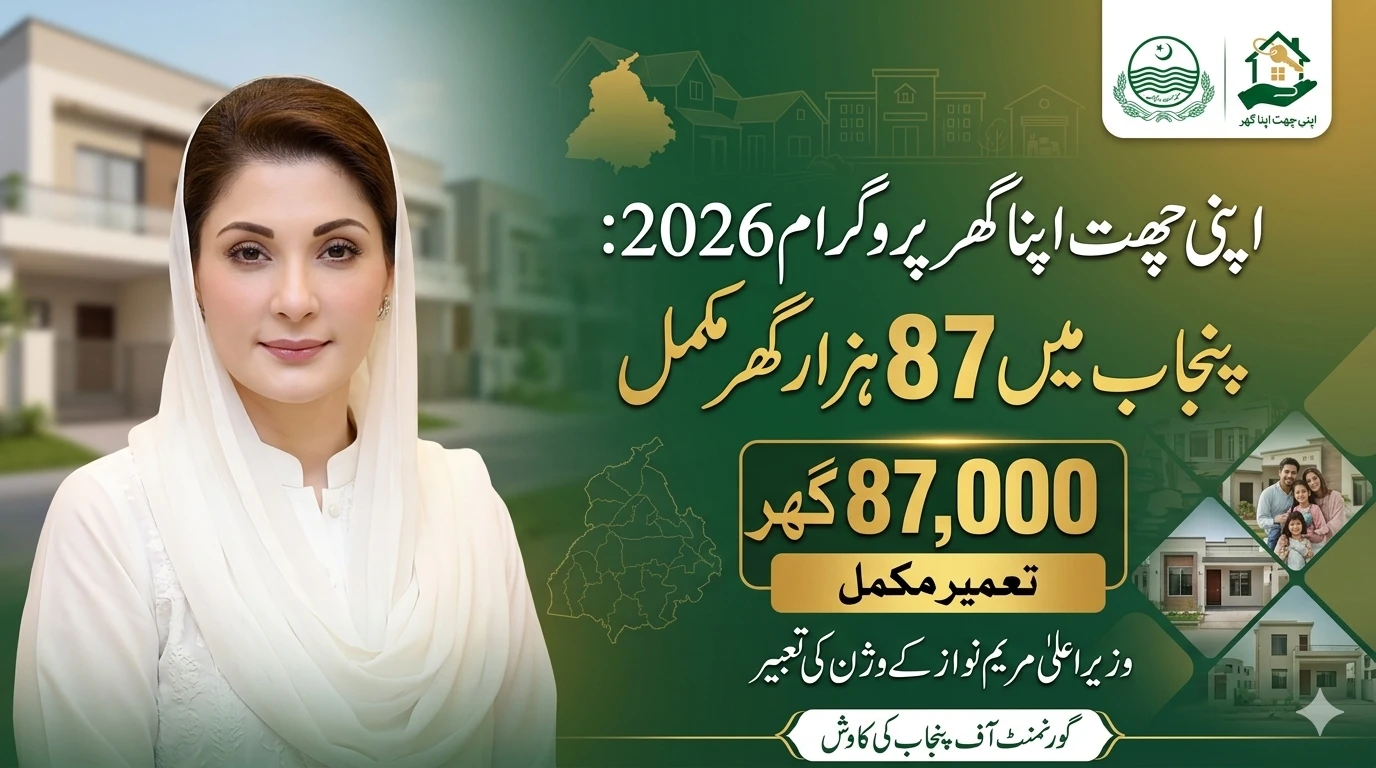
However, the year 2026 has brought a wave of hope across the province of Punjab. The provincial government has just announced a historic achievement. Under the flagship Apni Chhat Apna Ghar Program, the construction of 87,000 houses has been successfully completed. This isn’t just a win for the government; it is a life-changing moment for 87,000 families who now have a permanent address.
The Vision of Chief Minister Maryam Nawaz
Every major project needs a driving force, and for this housing scheme, it has been Chief Minister Maryam Nawaz. From the day she took office, she emphasized that housing should be a right, not a luxury. Her vision was simple: translate the “dream” of a house into a “reality” for the common man.
The Chief Minister has often stated that a roof over one’s head is the foundation of a stable society. When a family is secure in their home, they can focus better on education, health, and their jobs. This “person-first” approach is why the program focuses on affordability and speed. Completing 87,000 units in such a short span shows that the government prioritized people over paperwork.

How PHATA Turned the Tide
The Punjab Housing and Town Planning Agency (PHATA) has been the engine behind this massive achievement. Building one house is a task; building 87,000 is a logistical mountain. PHATA had to coordinate across dozens of districts, manage thousands of contractors, and ensure that quality was never sacrificed for quantity.
In a recent detailed update, the leadership at PHATA explained that they moved away from old, slow methods of construction. They adopted a more “smarter workflow” by using digital monitoring systems. This allowed them to see exactly which sites were falling behind and move resources there immediately.
The Importance of Quality Control
One of the biggest fears with government housing is that the quality might be poor. PHATA addressed this by implementing strict inspection phases. Before a house was handed over to a family, it had to pass checks for structural integrity, wiring, and plumbing. This ensures that the families moving in don’t face expensive repairs just a few months down the road.

Breaking Down the 87,000 Milestone
What does 87,000 houses actually look like? If you lined these houses up side-by-side, they would stretch for hundreds of kilometers. But more importantly, this milestone represents a massive shift in the provincial economy.
Economic Impact on the Province
The construction industry is a “multiplier.” When you build 87,000 houses, you aren’t just buying cement. You are:

- Supporting local brick kilns.
- Providing jobs for thousands of masons, carpenters, and electricians.
- Boosting the transport sector that moves materials from cities to rural sites.
- Helping the furniture and appliance markets as families move into their new spaces.
By investing in housing, the Punjab government has essentially injected billions of rupees back into the local markets. This creates a “win-win” situation where the poor get homes and the workers get wages.
Digital Transparency and Public Trust
In the past, many government schemes were criticized for being “hidden” from the public. The Apni Chhat Apna Ghar Program has changed that by using social media and digital portals. The Government of Punjab’s official YouTube channel has played a big role here.
By posting exclusive interviews with DG PHATA and showing real-life footage of the completed houses, the government has built trust. People can see the progress with their own eyes. This transparency makes it harder for corruption to take root and ensures that the public feels like they are part of the journey.
Who Qualifies for the Next Phase?
While 87,000 homes are a great start, the demand in Punjab is much higher. The government has signaled that more phases are on the way. The eligibility criteria have been kept simple so that the most deserving people can apply without needing a lawyer or a consultant.
- Residence: You must be a legal resident of Punjab.
- Income Level: The program specifically targets those in the low-to-middle income brackets.
- Property Ownership: Priority is given to those who do not currently own any other residential property in their name.
- Digital Application: Most of the process is handled through an online portal to ensure a paperless and fast experience.
The Role of Interest-Free Loans
A unique part of this vision is the provision of interest-free loans for those who already own a small plot of land but don’t have the money to build. This “self-build” model has helped speed up the 87,000 milestone because the government didn’t have to manage every single brick—they empowered the citizens to build their own “tabeer” (realization of a dream).
Social Stability and the Future of Punjab
A neighborhood of homeowners is very different from a neighborhood of renters. Homeowners take better care of their streets, they participate more in local schools, and they build stronger community bonds. By creating 87,000 new homeowners, the Punjab government is essentially creating 87,000 “anchors” for social stability.
Looking forward, the goal is to make these housing schemes even smarter. There are discussions about adding solar panels to future units to reduce the burden of electricity bills. The “Vision 2030” for transport is also being linked to these housing sites, ensuring that people living in these new homes have easy access to buses and trains to get to work.
Scaling Without Losing the Human Touch
As we talk about “scaling content” or “scaling construction,” it is easy to get lost in the numbers. But the 87,000 milestone is a reminder that scale works best when it stays human. Every one of those houses was built for a person with a story.
The success of the Apni Chhat Apna Ghar Program 2026 serves as a blueprint for other provinces. It shows that if you combine clear political will (from Maryam Nawaz), technical expertise (from PHATA), and digital transparency, you can achieve things that seemed impossible just a few years ago.
Conclusion: From Dream to Reality
The journey from a “khwab” (dream) to “tabeer” (realization) is rarely easy. It requires hard work, honest spending, and a lot of patience. Today, 87,000 families in Punjab are seeing the fruits of that labor. As they move into their new homes, the province takes one step closer to being a place where everyone has a safe place to call their own.
The Apni Chhat Apna Ghar Program is not just a housing scheme; it is a promise kept. And for the people of Punjab, that is the most valuable thing of all.
Frequently Asked Questions (FAQs)
1. How can I check if my name is in the list for the completed 87,000 houses?
The government typically releases the names of successful applicants through its official portal. You can also visit your local PHATA office or check the official Government of Punjab website for the latest lists and notifications.
2. What is the monthly installment for these houses?
The program is designed to be highly affordable. Depending on the specific category (urban vs. rural), the installments are often kept lower than the average monthly rent of a similar-sized house. Some phases even offer interest-free periods to help families settle in.
3. Is there a quota for widows or persons with disabilities?
Yes, the Punjab government usually sets aside a specific percentage of homes for vulnerable groups, including widows, orphans, and persons with disabilities. This ensures that the program reaches those who need the most support.
4. Can I sell the house after I get possession?
Usually, there is a “lock-in” period of several years during which you cannot sell the property. This is to prevent investors from buying up low-cost housing and to ensure that the homes stay with the families who actually need them for living.
5. How do I apply for the next phase of “Apni Chhat Apna Ghar”?
Keep an eye on the official Punjab government social media channels and the PHATA website. When a new phase opens, a “Join Now” or “Apply Online” button will appear on the portal. You will need your CNIC and basic income details to start the process.